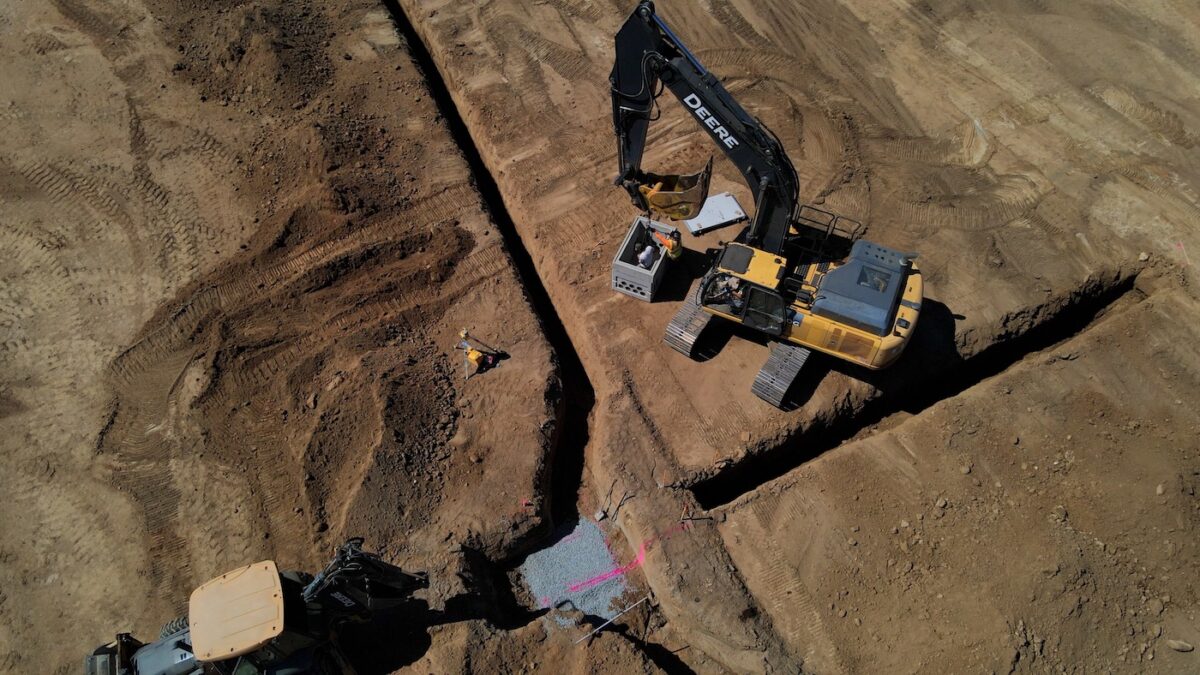
An excavator digs a trench for underground utility installation. Rise Utility, based in Fresno, designs underground utility systems and provides utility consulting and construction for developers across the Central Valley. Courtesy of Rise
Written by Branded content by David Arkin
Key takeaways
-
Keeping engineering and construction under one organization helps developers avoid communication gaps as projects move from design to execution.
-
Bringing experienced field personnel into the engineering phase allows constructability concerns to be addressed before plans are finalized, saving time during installation.
-
Working with one team from design through construction creates greater continuity for developers coordinating underground utility work.
-
Rise Utility leaders say collaboration and consistent communication have helped earn repeat business from developers across the Central Valley.
Every development project reaches a point where engineering gives way to construction, and for many developers, that’s also where communication becomes more complicated.
Plans move from one company to another, questions arise in the field that weren’t considered during design and responsibilities become divided just as work is beginning to accelerate.
Daniel Van Groningen believed that process could work differently.
After spending 14 years at PG&E in a variety of roles, Van Groningen developed a broad understanding of how utility projects move from the earliest planning stages through construction. Working across multiple departments gave him a perspective that extended beyond engineering alone, allowing him to see where projects slowed down and why communication sometimes became more difficult once work changed hands.
When he founded what would become Rise Utility in 2019, he set out to build a company that could remain involved throughout much of that process instead of participating in only one phase.
Today, the Fresno-based company provides utility consulting for public agencies while also designing underground utility systems for private developments across the region. When clients choose to continue with Rise Utility after the engineering work is complete, the same organization can carry those plans into construction, giving developers a single point of accountability from design through installation.
Why integrated utility design and construction matters
Van Groningen believes better projects begin with better conversations, particularly when the people responsible for doing the work have an opportunity to influence the design before plans are finalized.
“When you have a superintendent who’s an expert in constructability in the same room as your design team, the designer can ask questions before the plans are finalized,” he said. “Taking years of field experience and bringing that into the design phase creates value that’s difficult to quantify.”
Those conversations often involve details that may appear minor on a set of drawings but become much more significant once construction begins.
He said decisions about equipment placement, access for crews or the sequence of installation can all be discussed while plans are still evolving, giving engineers practical feedback before the project reaches the field.
Keeping projects moving from design through construction
The company’s work frequently begins when developers are preparing a new subdivision, commercial development or industrial project. As civil engineers establish grading plans and site layouts, Rise Utility develops the joint trench design that coordinates electric, gas and telecommunications infrastructure before working with utility providers through the review and approval process.
From there, developers have the option of continuing with the same team for construction rather than handing completed plans to another contractor.
That continuity, Van Groningen said, changes the conversation when unexpected challenges arise because everyone involved shares responsibility for delivering the same project.
“You don’t have the finger pointing,” he said. “The engineer can’t say the contractor didn’t build it correctly, and the contractor can’t say the engineer designed it wrong because you’re one company.”
Building relationships that last beyond one project
Cindy Cantu, Rise Utility’s director of administration and business development, said that collaborative approach is one of the reasons many clients continue working with the company long after their first project.
After joining Rise Utility following more than three decades in the industry, she said she was struck by how often customers talked about the relationship rather than simply the finished work.
“I have never been supported by a company the way I am with Rise,” clients have told her.
She said those conversations often focus on responsiveness, open communication and a willingness to offer ideas that improve a project before they become costly problems.
Rather than approaching each job as a transaction, she said the goal is to become part of the developer’s team and remain engaged from the earliest planning discussions until construction is complete.
Although Rise Utility has been in business for only a few years, its leadership team brings decades of experience working on utility projects throughout California.
Van Groningen believes that experience, combined with an approach that keeps design and construction connected instead of separated, gives developers something increasingly valuable as projects become more complex.
Related Posts
-
 Why more Central Valley developers are keeping utility design and construction together Posted: September 1, 2026 at 11:55 am
Key takeaways Keeping engineering and construction under one organization
Read more » -
 Subdivision with 180 homes planned for 38-acre parcel near Fowler Posted: August 27, 2026 at 10:57 am
A 38-acre agricultural parcel just outside Fowler could become 180
Read more » -
 Madera casino’s dining lineup includes Fresno’s Fuego, flagship steakhouse Posted: August 24, 2026 at 10:48 am
Fresno's Fuego Mexican Kitchen among eight venues at the Madera
Read more » -
 Fresno-based Icon Lending gets new president Posted: August 21, 2026 at 2:01 pm
Trumark Homes has named Marcus Murphy as president of Icon
Read more »
Central Valley Biz Blogs
-

OPINION: Who do you trust on SEDA?
Posted: August 31, 2026 at 3:45 pm
There are many voices weighing in on the SEDA (Southeast
Read more » -

OPINION: Newsom should veto ag wage hike that makes California food more expensive
Posted: August 28, 2026 at 12:38 pm
California politicians love the word "affordability." They put it in
Read more »