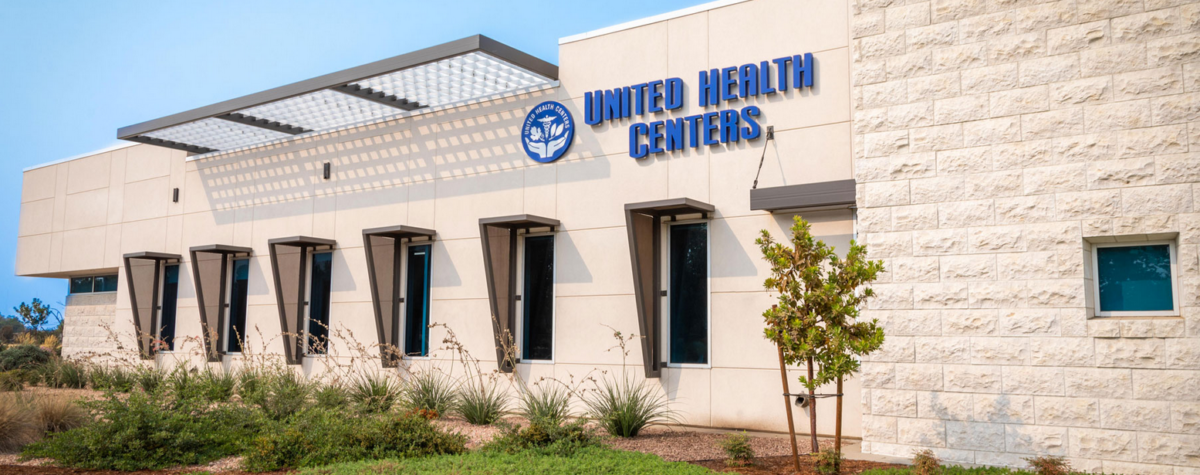
Photo of Clovis clinic via United Health Centers.
Written by Ben Hensley
Over the past several years, United Health Centers has quietly built a system designed to connect thousands of Central Valley patients with specialists faster — a move that leaders say is helping reduce delays in care for underserved communities.
United Physicians Network (UPN) functions as an Independent Physician Association (IPA), coordinating care between primary care providers, specialists and health plans for many of the organization’s patients.
United Health Centers (UHC) itself dates back decades; the federally-qualified health center was founded in 1971 and since has grown into one of the region’s most impactful health care providers, specifically targeting individuals and communities in areas that have historically been underserved.
The idea behind UPN emerged much later.
Discussions about creating a physician network began around 2020. That, however, led to several long years of planning and regulatory approvals before the model was able to become operational.
“Basically this was an idea probably back in 2020,” said UHC Contracting Manager Navjot Singh. “It took three to four years to reach full operation for this IPA.”
At its core, the network acts as a coordinating hub between patients, physicians and insurance plans, expediting the time it takes patients to go from initial consultation to their health care provider and, eventually, to specialty care services.
UHC has dedicated heavy focus towards expanding its specialty services in clinics throughout the Central Valley. However, the need remains great in the historically underserved region.
UPN aims to act as the middle-man between patients and the services they need.
“It basically is a delegated organization,” Singh said. “We contract with providers in the area…basically we’re the middleman between the [primary care physician], United Health Centers and the health plan.”

The network works through partnerships with major health plans, including Medi-Cal and Medicare Advantage programs — two programs that many UHC patients rely on.
Singh said UPN is “subdelegated by the health plans,” including Health Net, CalViva and Blue Cross, to manage services required under California health care regulations.
To carry out that work, the network maintains a large regional referral system, spanning all of its 40-PLUS clinics and specialty sites.
“We contract with about 2,500 specialty providers within the Central Valley, the local hospital organizations,” Singh said.
Those providers form the backbone of a referral network that helps to keep United Health Centers’ patients access care beyond primary medicine.
Preas said the organization has increasingly worked to bring many of those services closer to its own clients.
“We have the majority of specialties in-house,” said UHC CEO Justin Preas. “And we have multiple locations.”
Among those locations is a multi-specialty clinic located near Bullard and Cedar avenues, near an existing primary care center. UHC also operates two clinics at Community Regional Medical Center in Downtown Fresno — an ambulatory care clinic and a surgical clinic that the organization took over last summer.
Those sites allow physicians to refer patients internally when specialty services are needed, reducing the downtime between consultation and care.
“If it’s something we don’t have in-house, then we do have…a network of about 2,500 specialists outside of United Health Centers that we can refer patients to,” Preas said.
Preas said that was the main motivation behind the physician network in the first place — providing better care to UHC and Valley patients.
Access to specialists has long been a challenge in the Central Valley, in particular, for patients on Medi-Cal.
“One of the problems that underserved people — or people on the Medi-Cal program — have is access to timely and affordable specialty care,” Preas said.
Before the network was established, some patients experienced months between referral and appointment dates.
“We had different specialties prior to United Physicians Network that would take months for our patients to be able to get an appointment for,” Preas said. “We now can get them in within a week or two weeks.”
Beyond the improvement of access for patients, the model also helps physicians manage care more effectively.
Preas said the expanded network can also serve as a recruiting tool for doctors considering employment in the Central Valley with UHC.
“When they know that we have all of these services that their patients have such greater access to, that definitely factors in,” he said, adding that the expansion also plays a role in reducing pressures on hospital emergency departments. “It’s our job to keep people out of the hospital.”
Without timely outpatient specialty care, many patients turn to emergency rooms — a costlier option that also bottlenecks patients in hospitals, further pressing the already overstressed emergency department operations.
“If there’s not accessible and affordable alternatives for patients for specialty care, they’re going to wind up in the hospital,” he said.
Today, the scale of UHC’s patient population reflects the growth of the network; just a few years ago, the provider served around 100,000 patients.
Today, they serve roughly 200,000.
Of those 200,000, approximately 155,000 patients, including around 145,000 Medi-Cal members and 10,000 Medicare Advantage members, are managed through UPN — more than 70% of the provider’s total patient count.
For now, UPN only serves patients in the UHC system, but leaders hope the network could expand in the future.
IPAs can contract with outside providers, Preas said, but the organization has chosen to focus first on its existing patient base before expanding.
“Our first goal was our patients at UHC and making sure we were doing a good job with our patients,” he said.
Expanding the network beyond that will require careful planning to ensure adequate specialist coverage and maintain compliance with health care regulations.
“We have to ensure that the amount of members we care for… have appropriate access to specialty care,” Singh said.
For now, leaders say the priority remains strengthening and reinforcing the system they have built — and ensuring patients across the Central Valley can access care quickly.
“It’s a massive project that we undertook,” Preas said, “and it’s a lot of people that we are responsible for.”
Related Posts
-
 Why We Showed Up: Local vendors on the business of giving back Posted: May 8, 2026 at 4:29 pm
Four vendors at FoodLink for Tulare County's inaugural Beats &
Read more » -
 Canvas data breach hits Fresno campuses days before finals Posted: at 2:23 pm
With finals less than a week away, the platform where
Read more » -
 KMJ revives Valley history radio series with new voices, expanded format Posted: at 12:03 pm
A longtime Valley storytelling series made its return to KMJ
Read more » -
 Fresno recycling facility adds AI robots, expands capacity with $4.5M state grant Posted: May 7, 2026 at 4:58 pm
Mid Valley Disposal has planned a ribbon cutting ceremony later
Read more »
Central Valley Biz Blogs
-

BLOG: One hundred organizations can’t all be wrong
Posted: May 8, 2026 at 3:21 pm
One hundred organizations just signed onto the Building an Affordable
Read more » -

BLOG: Introducing the Philanthropy Excellence Awards, celebrating community impact
Posted: May 6, 2026 at 1:22 pm
At The Business Journal, storytelling has always been at the heart
Read more »