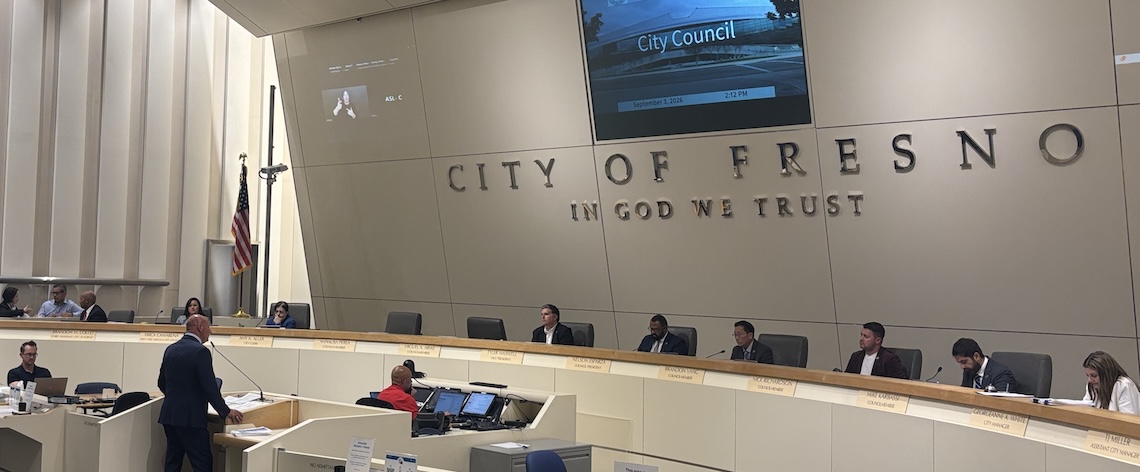
Fresno’s controversial Southeast Development Area (SEDA) Specific Plan has been tabled indefinitely by the Fresno City Council, effectively bringing the massive development proposal to an end after years of planning and debate.
Councilmember Annalisa Perea confirmed the decision in a statement released Thursday, Nov. 5, following the council’s consideration of the plan, which encompasses approximately 9,000 acres and could eventually accommodate as many as 45,000 homes.
“While this action does not formally reject the proposal, the reality is that it effectively brings the current plan to an end,” Perea said.
Councilmember Mike Karbassi made the motion to table the project, while Councilmember Nick Richardson was the lone dissenter to that motion, Fresnoland reported.
The decision marks a significant setback for a proposal intended to accommodate Fresno’s future housing, commercial and industrial growth while generating additional local government revenue.
Perea said she supports planning for the city’s long-term growth but could not support the proposal as presented.
“After reviewing the proposal and considering the many concerns raised throughout this process, I could not support its approval in its current form,” Perea said.
She said too many outstanding issues remained unresolved despite extensive discussions and public participation.
Years of debate over Fresno’s future growth
SEDA has been among Fresno’s most closely watched development proposals, with supporters promoting its potential to expand housing opportunities, attract business investment and generate new tax revenue.
Opponents have questioned the cost of extending infrastructure into undeveloped areas and argued that Fresno should concentrate resources on existing neighborhoods.
The proposal underwent revisions in response to those concerns, including a phased approach that would have initially concentrated development in the smaller South SEDA area.
Under the revised plan, development beyond the initial phase would have required additional environmental and financial analysis after specified development thresholds were reached.
The Fresno Planning Commission recommended approval of the plan and its environmental impact report in August, setting up the Nov. 5 council consideration.
$2.5 billion economic projection preceded decision
The council’s decision comes shortly after the Building Industry Association of Fresno and Madera Counties (BIAFM) released an economic analysis projecting that SEDA could generate $2.5 billion more in local government revenue than public costs over 15 years.
The study, conducted by the National Association of Home Builders, projected $3.9 billion in local government revenue against $1.4 billion in public costs.
It assumed construction of 1,500 homes annually, totaling 22,500 homes over 15 years, and projected $17.7 billion in local income and 232,039 full-time job years across Fresno and Madera counties.
Darren Rose, BIAFM president and CEO, previously said the findings challenged concerns that the expansion would strain city finances.
“Even when you stack every assumption against development, SEDA pays back its infrastructure in four years and then delivers a growing surplus for decades,” Rose said ahead of the vote.
The association’s study differed in scope from an analysis prepared by Economic & Planning Systems, the city’s consultant, which examined the initial South SEDA development phase rather than the larger expansion.
Opponents remained skeptical of the financial projections.
Dillon Savory, executive director of the Fresno-Madera-Tulare-Kings Central Labor Council, previously argued that the city could not afford the infrastructure investment while facing budget pressures and deferred maintenance.
“There’s no money for this type of a project,” Savory said ahead of the council decision.
Savory also questioned demand for additional industrial development and argued that existing growth areas could accommodate Fresno’s housing needs.
What comes next for SEDA?
The council’s decision to table the plan indefinitely leaves the future of development in southeast Fresno uncertain.
Although the action does not constitute a formal rejection of SEDA, Perea’s statement indicates that the current proposal has reached an endpoint.
The statement does not outline a timetable for revisiting the plan or developing an alternative.
Perea said the council’s responsibility was to determine whether the proposal represented the right approach for Fresno, rather than approve it simply because of the time already invested.
“Fresno needs to plan for its future, but we also need to get it right,” Perea said. “A plan of this magnitude will have lasting consequences for our city, and we owe it to our residents to make decisions based on what makes sense for Fresno, not simply on how long a proposal has been under consideration.”