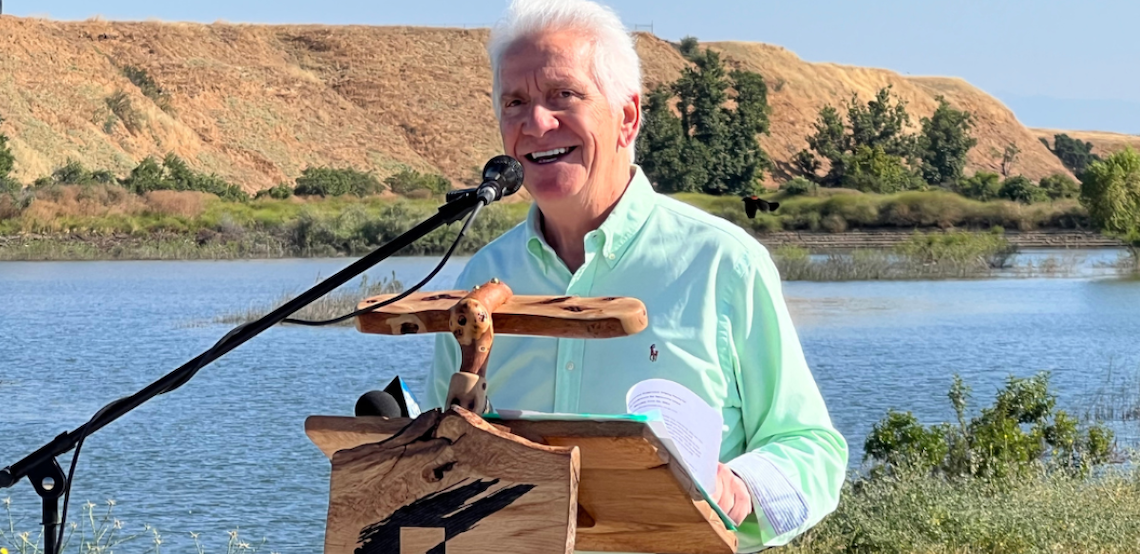
Rep. Jim Costa is backing legislation to study how the growth of artificial intelligence data centers could affect energy supplies, water resources and utility costs, particularly in rural communities. (Photo courtesy of the Office of Rep. Jim Costa)
Written by Business Journal staff
Rep. Jim Costa highlighted legislation aimed at examining how the rapid expansion of artificial intelligence and data centers could affect energy supplies, water resources and utility costs, including in rural communities.
During a telephone town hall Thursday, Costa raised concerns about the resources required to support data centers as AI use expands. He said the technology could create opportunities in healthcare, education, agriculture and other industries, but warned that data centers require large amounts of electricity and can also place significant demands on water supplies.
Costa introduced H.R. 5227, the Unleashing Low-Cost Rural AI Act, on Sept. 9, 2025. The bipartisan bill, which has six cosponsors, was referred to the House Committee on Science, Space, and Technology and remains at the introduced stage.
The legislation would require the Secretary of Energy to designate a national laboratory to study the effects of AI and data-center growth on U.S. energy resources.
Studying the impact of data centers
The study would examine whether existing infrastructure needs upgrades to accommodate AI and data centers, as well as the industry’s potential effects on energy costs, energy supply and reliability, land use, water use and costs to consumers. The legislation calls for prioritizing the effects of AI and data-center growth in rural areas.
The bill would also examine the feasibility of locating AI and data centers alongside energy resources, including nuclear and geothermal facilities, hydroelectric dams, solar and wind projects, battery storage and carbon capture facilities.
Costa said during the town hall that the potential impact on Central Valley consumers is among his concerns.
“I don’t want families in Fresno, and Tulare to have higher utility cost because we failed to plan for the growth,” Costa said.
Valley should benefit without higher bills
Costa said he supports the economic opportunities AI could create but argued that policymakers need to better understand the potential consequences of data-center expansion.
He cited California Energy Commission projections that data centers’ share of peak electricity demand in the state could grow from 2% to 9% by 2040 and said the Valley should be able to benefit from new technology without being left with higher electricity bills or unaccounted-for impacts to its water resources.
Other Valley concerns
Costa also addressed a range of cost-of-living issues during the town hall, including housing, food, fuel and healthcare.
Responding to a Visalia caller concerned about buying a first home, Costa discussed efforts to increase housing supply, expand access to rural homeownership and reduce construction costs. He also criticized tariffs on construction materials, saying they add to the cost of building and buying homes.
Tariffs came up again when a caller asked about rising grocery prices. Costa argued that tariffs increase costs for consumers, manufacturers and farmers and discussed legislation he supports to limit the president’s ability to impose tariffs using emergency powers.
On healthcare, Costa said more than 28,000 families in his district have relied on enhanced Affordable Care Act tax credits to keep coverage affordable. He also discussed potential impacts from Medicaid changes on Valley hospitals, clinics and patients.
A Sanger caller asked about the future of CalFresh benefits. Costa said changes beginning in 2027 could require states to pay a portion of Supplemental Nutrition Assistance Program costs based on their error rates. He said California’s most recent error rate was 11% and expressed concern that additional state costs could eventually result in cuts, tighter eligibility or other changes.
Costa also addressed gasoline and diesel prices, saying higher fuel costs are putting additional pressure on Valley households and agricultural operations.
Related Posts
-
 Costa touts bill to study AI data centers’ energy, water impacts Posted: August 28, 2026 at 2:40 pm
Rep. Jim Costa highlighted legislation aimed at examining how the
Read more » -
 Fresno State extends athletic director Garrett Klassy’s contract through 2031 Posted: at 1:37 pm
Fresno State has extended Director of Athletics Garrett Klassy’s contract
Read more » -
 Former Radisson Hotel in Downtown Fresno hits the market at a higher price Posted: at 10:28 am
The former Radisson Hotel in Downtown Fresno is back on
Read more » -
 Buying Dutch Bros on Friday will support RMHC Central Valley Posted: August 27, 2026 at 5:25 pm
Dutch Bros Coffee and Ronald McDonald House Charities of the
Read more »
Central Valley Biz Blogs
-

OPINION: Newsom should veto ag wage hike that makes California food more expensive
Posted: August 28, 2026 at 12:38 pm
California politicians love the word "affordability." They put it in
Read more » -

BLOG: Dolly Parton is gone at 80, but her books keep arriving in Fresno County mailboxes
Posted: August 25, 2026 at 11:41 am
The country legend built an Imagination Library that reached 13,000
Read more »