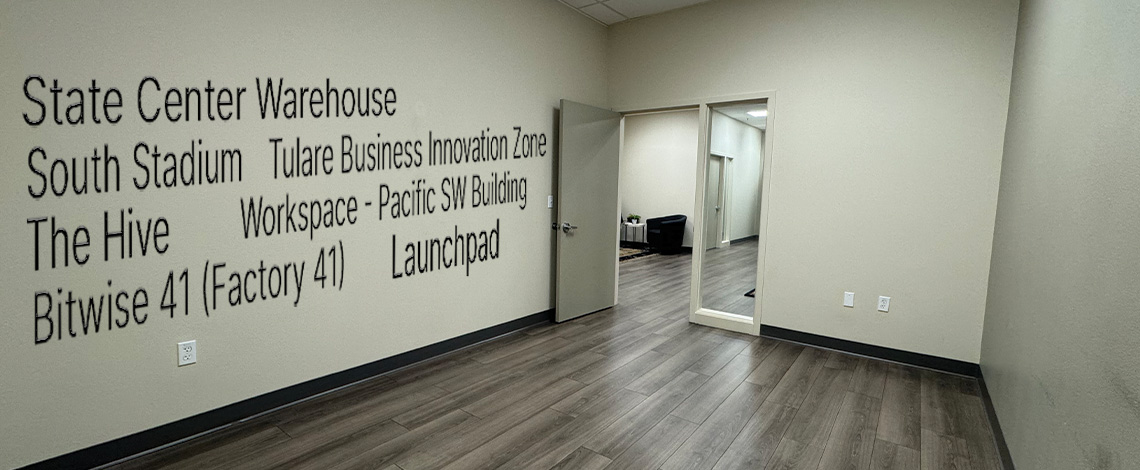
Coworking spaces in Fresno and across the Central Valley are evolving as operators adapt to post-pandemic demand and shifting local business needs. Photo via The Launchpad. Illustration by Israel Meave
Written by Dylan Gonzales
Coworking spaces across Fresno and the Central Valley are at an important crossroads as they still feel the impact of the pandemic and the Bitwise collapse, while also balancing slow local adoption with larger statewide momentum and potential for long-term growth.
Flexible office spaces have transformed major metropolitan markets such as Los Angeles and San Francisco. Meanwhile, Fresno’s coworking sector remains in an earlier stage of development. Local real estate professionals attribute this challenge to density. While the greater Fresno area has more than 500,000 people, they are more spread out than the larger cities across the state and country.
“We don’t have the population density in Fresno, specifically downtown, to support it,” said Will Dyck, president of Summa Development Group. “So it works in large cities, but in Fresno, it has not been very popular, especially downtown – but that is changing now.”
After Bitwise, a new model
The dynamic has led to some mixed results. A previously inherited coworking space tied to Bitwise Industries failed to cover even half of its operating costs and was quickly shut down. However, Dyck said a new model is in the works and is expected to launch in around six months.
Before its collapse, Bitwise was slated to have 94 tenant spaces specifically downtown within Downtown Fresno. The 94 spaces were divided among four locations — Bitwise I 41 (16 spaces), South Stadium (36 spaces), State Center Warehouse (26 spaces) and The Hive (18 units). Together, those four properties represented nearly 200,000 square feet of potential coworking inventory in the urban core. Today, State Center Warehouse and South Stadium — at 100,000 and 50,000 square feet respectively — remain among the largest potential coworking footprints in the downtown market, though rental rates and terms have not been publicly disclosed as redevelopment plans take shape.
National operators fill gap
While the downtown coworking market is looking to heat up again, national operators like Regus have found some success in Fresno by relying on enterprise-level demand. Regus offers one of the most comprehensive menus of flexible workspace in the market — from hourly desks and day offices to virtual plans, training rooms and boardrooms — with pricing available on request. Their model often focuses on corporate clients with pre-existing contracts who need flexible workspace across multiple markets.
The built-in tenant base limits relying on purely local demand, which is a key advantage in cities like Fresno.
“We see coworking spaces as a form of a business incubator, offering right-sized space that allows businesses to grow on their own terms, stabilize costs and scale over time,” said Fresno County Economic Development Corporation CEO Will Oliver. “We’ve worked with countless clients that got their start in these environments, so I do see co-working as an important part of our broader office mix, from Downtown Fresno to smaller rural cities.”
That broader mix now extends well beyond the city limits. The Tulare Business Innovation Zone, located at 425 E. Kern Ave. in Tulare, offers 15,000 square feet across 12 rentable rooms — including conference rooms, coworking space, a maker space and a small business development center — with amenities like complimentary coffee, ergonomic furniture and high-speed Wi-Fi. It represents the kind of smaller-city coworking infrastructure Oliver described.
The grassroots tenant
Locally, the average coworking tenant is much more grassroots, trying to launch their career or settle down as they near retirement.
“We found the most interest in people that don’t want to work on their kitchen table,” Dyck said. “They’re not really a full time or a thriving business yet, and they just need an address, someplace to work where they’re not bothered by kids or phones ringing, or whatever the trials of life are. It gives them a location that they can focus.”
Dyck’s thinking aligns with what The Launchpad has built in North Fresno. The Launchpad is a coworking space founded in 2018 by Mendy Laval and her family. It was originally created to support startups and entrepreneurs. Eight years later, the space is now a hub with a variety of users.
“We have realtors, we have lawyers, we have banks that are moving into the area. You name it,” Laval said. “We’ve also seen people at the end of their careers coming in as they’re winding down practices. It’s kind of a launch pad and a landing pad to us, and we get a wide variety of tenants.”
Flexibility selling point
The Launchpad model showcases flexibility and no commitment. Tenants can access private offices, shared workstations and conference rooms without long-term leases or upfront costs often associated with traditional office space.
The flexibility has become increasingly valuable in the post-pandemic world, where hybrid work has reshaped office demand.
“They don’t want to commit to a 5,000 square foot office space,” said Veronica Stumpf, a CCIM broker with Stumpf & Co. Real Estate. “They don’t want to commit to a five year lease, and a co working office space is highly attractive to them because it’s all inclusive and they know what they’re paying in rent includes everything they need.”
That all-inclusive appeal shows up across the market’s directory of smaller providers. A cluster of small office suites — operated under the smallofficesuites.com banner across Fresno, Clovis and Sanger — offer month-to-month, flexible leases with utilities included and starting rents ranging from roughly $425 a month in Sanger to $595 a month at East Perrin and North Maple locations in Fresno. Units typically run between 190 and 260 square feet and come pre-wired with phone lines and access to AT&T fiber optic and Comcast connections. For solo professionals and micro-businesses, these spaces represent one of the most accessible on-ramps into dedicated office life without the commitment of a traditional lease, experts say.
Downtown’s next chapter
In Downtown Fresno, the demand is trending up even outside of coworking. Small office suites, which are often under 1,000 square feet, are leasing quickly. However, coworking’s role in the downtown landscape is still uncertain.
Outside of the former Bitwise properties, the Pacific Southwest Building at 1060 Fulton St. offers coworking through memberships and day passes across 13,000 square feet, with 24/7 access, Wi-Fi, conference rooms, mail services and event space — one of the more fully featured downtown options currently operating.
“There is that demand for small move-in ready office space where a tenant knows what their expenses are,” Stumpf said. “They can move in quickly. It eliminates any question marks whether the startup costs will eat up their budget.”
A stepping stone
One of the advantages of coworking space is the shared environments and amenities. Many Fresno users also are interested in avoiding long-term commitments and unpredictable costs.
For many tenants, coworking serves as a traditional step for small businesses. Many startups use it to test viability before expanding into traditional office spaces. Even out-of-market companies use it as a temporary base to explore potential expansion opportunities in the Central Valley. The Student Hatchery at Fresno State’s Lyles College of Engineering provides physical office space, boardroom access and classroom space for early-stage ventures still in formation — feeding a pipeline of future tenants into the broader market.
“We have people from out of town that are finding us from the Bay Area and we have people as far back as Chicago and the East Coast, if they need a place to come while they’re getting sort of a lay of the land in our community and where they want to be,” Laval said.
Not all coworking users move on to their own spaces. Some remain for the long haul, primarily consultants, solo professionals and small teams who place a high value on convenience over ownership.
Growth trends
Recent industry data shows that the larger trends are working in coworking’s favor. According to Yardi Kube, a Canadian-based coworking management platform, the Central Valley added 12 new coworking locations over the past year, reaching 54 total, and a 29% year-over-year increase. Nationally, coworking inventory has grown to 161 million square feet, reflecting continued demand for flexible real estate solutions.
For Fresno however, growth remains the most important factor in the equation.
“Every day that the city grows, and especially the density of downtown increases, it makes it more and more viable,” Dyck said. “It’s still in its infancy as far as coworking, but we’re getting there. We’re on the right track to make it a more viable option.”
Related Posts
-
 California Teaching Fellows Foundation honors 40 Central Valley educators in second annual campaign Posted: May 1, 2026 at 3:36 pm
The California Teaching Fellows Foundation is celebrating over 40 teachers
Read more » -
 James G. Boswell Foundation donates bedside cameras to Valley Children’s NICU to keep families connected Posted: at 2:56 pm
The NICU at Valley Children’s Hospital in Madera now has
Read more » -
 Not Just ‘Mailbox Money’: Local brokers talk hidden risks of triple-net leases Posted: at 12:58 pm
Triple-net lease investments, which have long been associated with passive
Read more » -
 Business Journal’s Hensley brews up Gruner Award with small business feature Posted: at 12:35 pm
A story about the dream of opening a coffee shop
Read more »
Central Valley Biz Blogs
-

BLOG: Two decades in, I’m still learning from this community
Posted: April 28, 2026 at 12:44 pm
I’m so grateful for all of the people who went
Read more » -

BLOG: JPMorgan, BNY Mellon roll out deposit tokens, lobby to restrict non-bank stablecoins
Posted: April 27, 2026 at 1:35 pm
While the Clarity Act remains stalled in Congress over the
Read more »