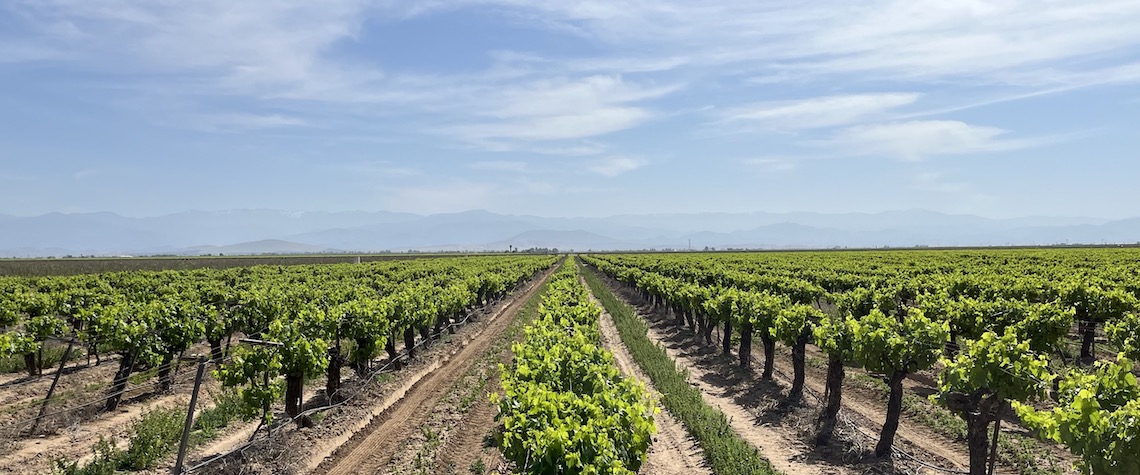
Grapevines stretch across a Sun-Maid Growers vineyard in California's Central Valley. Sun-Maid photo
Written by Vikaas Shanker
More than 1,500 raisin growers in the Central Valley produce every commercial raisin sold in the United States. Over the past decade, they’ve watched production fall 38% — from roughly 366,000 tons in 2014 to 226,000 in 2024 — as labor costs climbed, more profitable nut crops took over vineyard acreage, and family operations approaching a century in production faced the question of whether to replant, pivot or sell.
The ones who stayed may be the most competitive version of the industry in a generation.
“California raisin growers are perhaps the savviest farmers on the planet,” said Jeff Smutny, president and managing director of the Raisin Administrative Committee. Post-recession cost pressures and California’s regulatory environment kept growers “elastic to change and open to innovation,” he said.
That adaptation has taken concrete forms: a shift toward higher-yield grape varieties, wider adoption of dry-on-vine systems that let grapes dry naturally on the vine and reduce labor, and a sharper focus on harvest timing. Raisins are especially vulnerable to late-season rain, so some growers now prioritize varieties they can bring in by August — reducing exposure before fall weather arrives.
The 2026 outlook is better than it’s been in years. Production is projected to exceed 200,000 tons, boosted by a strong Central Valley harvest, weaker yields from competitors in Turkey, South Africa and Chile, and a decline in wine grape demand that has redirected some tonnage into raisin production. Tariffs on imports have made California-grown raisins more attractive to domestic buyers.
The industry has also found an unlikely ally in updated federal nutritional guidelines, which now emphasize natural, high-fiber, low-added-sugar foods. “These guidelines have just made it clearer that California raisins meet the definition of healthy foods,” said Steve Loftus, president and COO of Sun-Maid.
What the industry is fighting harder to defend is its place on the grocery shelf — and inside the products it’s always called home. Shrinkflation has quietly trimmed the raisin count in packaged foods, and the Raisin Administrative Committee is pushing back through retail partnerships and international marketing.
“In some cases, a muffin may have included five raisins but now includes four,” Smutny said. “We are trying to address those types of things.”
One raisin at a time.
Related Posts
-
 Raisin Outlook 2026: Trends leave industry leaner, ready to compete Posted: May 4, 2026 at 9:45 pm
More than 1,500 raisin growers in the Central Valley produce
Read more » -
 Farm bill clears House with wins for Valley growers, questions on food aid Posted: April 30, 2026 at 3:33 pm
The House passed a $390 billion farm bill Thursday after
Read more » -
 Fresno man sentenced in $5M canola theft scheme Posted: April 28, 2026 at 10:04 pm
Richard Best, 72, of Fresno, was sentenced Monday by the
Read more » -
 Inside HotSpot AG, the Central Valley firm teaching the world to farm smarter Posted: April 27, 2026 at 3:48 pm
A Hanford company that helps Central Valley growers manage their
Read more »
Central Valley Biz Blogs
-

BLOG: One hundred organizations can’t all be wrong
Posted: May 8, 2026 at 3:21 pm
One hundred organizations just signed onto the Building an Affordable
Read more » -

BLOG: Introducing the Philanthropy Excellence Awards, celebrating community impact
Posted: May 6, 2026 at 1:22 pm
At The Business Journal, storytelling has always been at the heart
Read more »