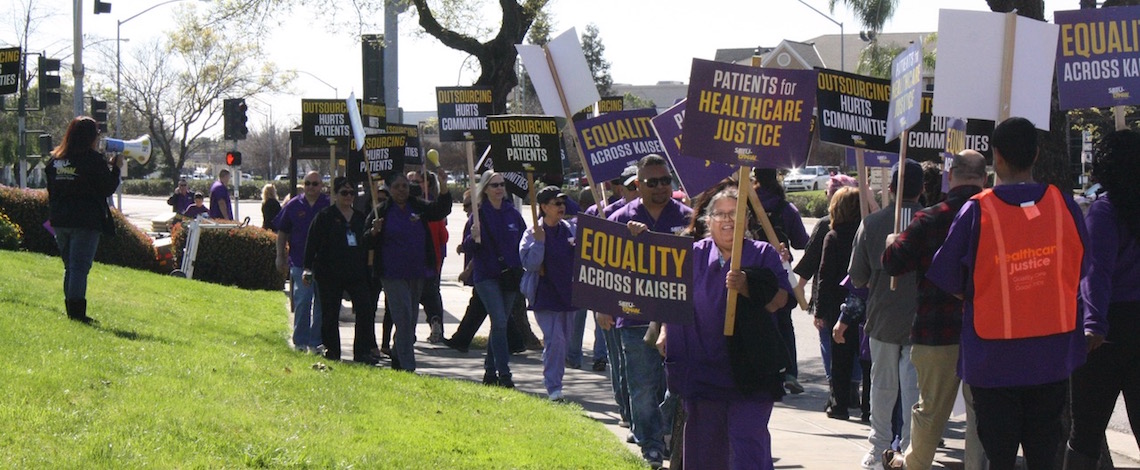
SEIU-United Healthcare Workers employees stage a protest at Kaiser Permanente Fresno Medical Center in 2018. File photo
Written by Ben Hensley
Kaiser Permanente officials issued a statement Wednesday, calling the ongoing strike at hospitals in California, Oregon and Washington “unnecessary and disruptive,” adding that negotiations have been ongoing for over four months, as both sides continue to work to reach new national and local agreements to support employees across multiple regions.
The strike, which includes members of the United Nurses Association of California/Union of Health Care Professionals (UNAC/UHCP), represents nearly 2,800 health care workers, including nurse anesthetists, certified nurse midwives, acupuncturists, occupational, speech and physical therapist, physician assistants and other skilled positions, revolves around wages.
There is no strike activity currently in Fresno, according to a Kaiser representative.
Kaiser said its proposal recognizes the contributions of its employees, calling its compensation package a “strong, comprehensive offer,” adding that Alliance-represented employees earn, on average, 16% higher pay than their peers.
Kaiser Permanente’s proposal includes a 21.5% increase in wages over the next four years, as well as an additional 0.5% increase at each local bargaining table, annual salary-step increases and additional market wage adjustments, adding up to as much as 3% to base salaries in some regions.
“The seemingly small percentage difference between the two proposals actually means significantly more because it is multiplied across 60,000 employees and causes related benefit increases over four years,” a news release reads. “The difference between a 21.5% and a 25% increase is about $300 million a year in salary alone by the end of the contract.”
Kaiser said that UNAC/UHCP is requesting a 25% wage increase over the next four years.
Under its current payroll, UNAC/UHCP employees payroll totals $6.3 billion annually; Kaiser’s wage offer would increase pay by $1.9 billion by the final year in its contract. The union’s proposal would increase pay by $2.2 billion.
Kaiser says that additional wage increases would force the provider to pass down higher prices for Kaiser Permanente members.
“At a time when the cost of health care continues to go up steeply, and millions of Americans are having to make the difficult choice to go without coverage, it’s critical that we keep quality, accessible health care coverage affordable – while attracting and retaining top talent and keeping Kaiser Permanente a great place to work and receive care,” the release adds. “Our offer does all this.”
Through more than 900 local bargaining sessions, Kaiser said that it has reached 52 tentative agreements, achieving comprehensive agreements at 17 of 54 local bargaining tables. The company said it has enhanced proposals, initiated mediation and extended bargaining, even after receiving the 10-day strike notification on Oct. 3.
During the strike, Kaiser said that its hospitals and medical offices will remain open, with members continuing to be able to access 24/7 same-day care through the Get Care Now feature on its mobile app.
Overall, about 3% of appointments, surgeries and procedures across Northern California are being rescheduled.
Related Posts
-
 California Teaching Fellows Foundation honors 40 Central Valley educators in second annual campaign Posted: May 1, 2026 at 3:36 pm
The California Teaching Fellows Foundation is celebrating over 40 teachers
Read more » -
 James G. Boswell Foundation donates bedside cameras to Valley Children’s NICU to keep families connected Posted: at 2:56 pm
The NICU at Valley Children’s Hospital in Madera now has
Read more » -
 Not Just ‘Mailbox Money’: Local brokers talk hidden risks of triple-net leases Posted: at 12:58 pm
Triple-net lease investments, which have long been associated with passive
Read more » -
 Business Journal’s Hensley brews up Gruner Award with small business feature Posted: at 12:35 pm
A story about the dream of opening a coffee shop
Read more »
Central Valley Biz Blogs
-

BLOG: Two decades in, I’m still learning from this community
Posted: April 28, 2026 at 12:44 pm
I’m so grateful for all of the people who went
Read more » -

BLOG: JPMorgan, BNY Mellon roll out deposit tokens, lobby to restrict non-bank stablecoins
Posted: April 27, 2026 at 1:35 pm
While the Clarity Act remains stalled in Congress over the
Read more »