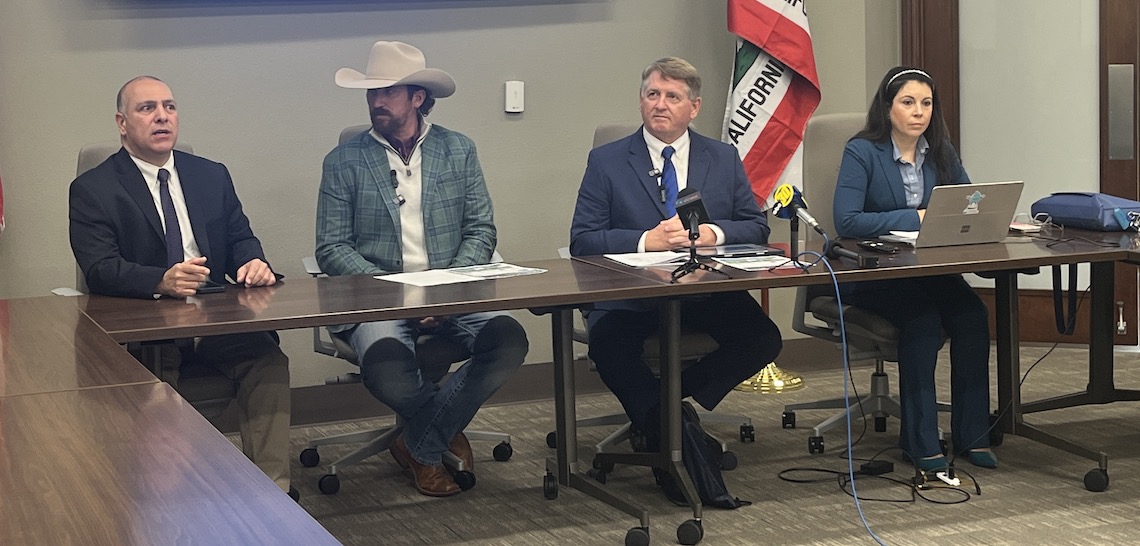
Speakers detail the most recent Westlands Water District economic impact report. From left: Matthew Jendian, Nick Rocca, Michael Shires and Elizabeth Jonasson. Photo by Frank Lopez
Written by Frank Lopez
A recent report from the Westlands Water District highlights the economic impact the entity brings to the San Joaquin Valley and across the state.
Last week, Westlands released its 2025 Economic Impact Report, providing a comprehensive analysis of the district’s economic contributions using the most recent available data from 2022.
The report follows up Westlands’ 2022 Economic Impact Report, which analyzed 2019 data, to allow for a clearer comparison of how water availability and market conditions have shaped the region’s economy over time.
In 2019 Westlands received a 75% water allocation and the year before it received a 50% allocation. From 2021-2022, the allocation was 0%.
Allison Febbo, general manager of Westlands Water District, said water for Westlands growers fuel the regional economy.
“Thousands of families, small businesses and essential public services depend on the economic activity generated by agriculture in our district. This report reaffirms how central reliable water supplies are to keeping our communities strong and healthy,” Febbo said.
The report was prepared by Dr. Michael Shires, former professor and vice dean at the Pepperdine School of Public Policy and nationally recognized economist specializing in regional economic development and public finance.
It was also conducted by Dr. Matthew Jendian, a sociology professor and founding director of the Humanics Program in Philanthropic and Community-based Leadership.
According to the report, in 2019 the 75% water allocation allowed Westlands agriculture powered over $4.7 billion in economic activity, and supported over 35,000 jobs and generated tax revenues of over $705.5 billion.
However, after two years of zero federal water allocation, the region’s total economic activity had dropped by 25% — a $1.2 billion loss.
This also led to 7,500 jobs vanishing — enough to have put a fifth of Fresno County’s unemployed back to work.
Crop production value fell 28% and secondary ag businesses lost 20% leading to local government tax revenues shrinking by $96 million, slashing funds for schools, roads and public safety.
The report also details the economic impact of fallowed ag land.
Restoring fallowed acres since 2019 could have meant $202.2 million more in fruit and nut production from Westlands growers in 2024, almost offsetting the amount of imports, according to the report.
Secondary ag businesses saw a loss of 20% — about $1.1 billion.
“These findings highlight both the resilience of our growers and the real costs of uncertainty,” said Shires. “Westlands agriculture remains a powerful economic driver. But when water supplies fall short, the impact is immediate and felt across every sector, from farmworkers to truck drivers to local schools and businesses.”
Related Posts
-
 Farm bill clears committee, heads to House floor Posted: March 9, 2026 at 4:58 pm
A new farm bill is closer to being approved after
Read more » -
 BLOG: From a farmer who’s been there — immigration reform can’t wait Posted: March 2, 2026 at 4:45 pm
Dear President Trump and Congress, This has gotta stop. It
Read more » -
 Valley farmers, elected officials blast 15% CVP water allocation Posted: February 26, 2026 at 2:38 pm
Local farmers and Valley congressmen pushed back Thursday after the
Read more » -
 $1B lifeline for struggling specialty crop farmers has arrived Posted: February 23, 2026 at 5:47 pm
California growers are breathing a little easier after the U.S.
Read more »
Central Valley Biz Blogs
-

BLOG: For the Central Valley, policy must work in practice — not just on paper
Posted: March 12, 2026 at 12:40 pm
For the Central Valley, Sacramento is not abstract. State policy
Read more » -

BLOG: California’s tribal casinos trample smaller cardrooms with new regulations
Posted: March 11, 2026 at 9:18 am
While writing a book about California politics a quarter-century ago, I devoted
Read more »