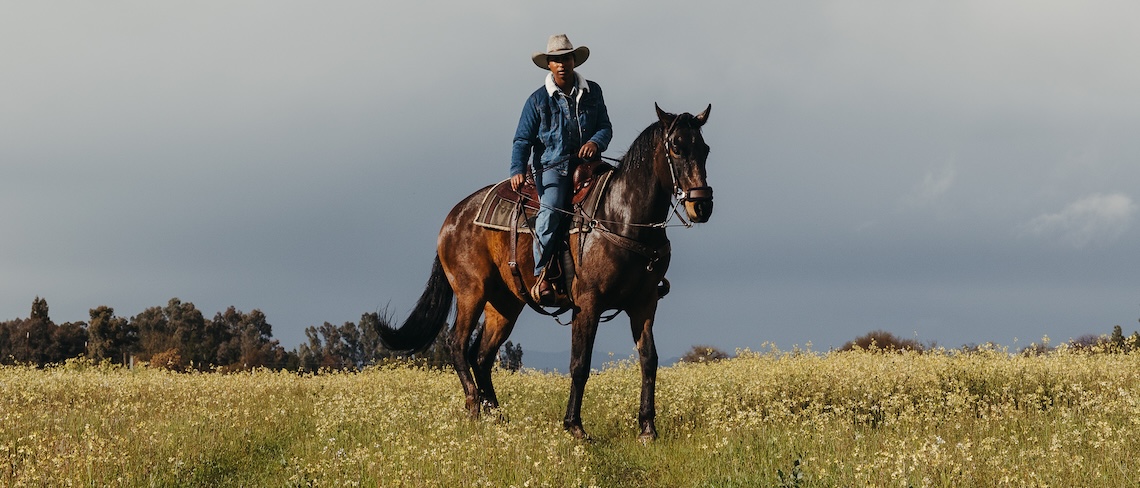
Rizpah Bellard, founder of Nova Farming, on horseback in the Central Valley. The 31-year-old rancher, educator and housing advocate is working to reshape what agriculture looks like for the next generation of Central Valley students. Photo contributed
Written by Frank Lopez
The day Cleveland Bellard’s path toward agriculture began, he was 10 years old and trespassing.
He had snuck onto private property in Richmond, chasing rabbits with his dog, when the farm foreman caught him. Instead of sending him home with just a warning, the foreman walked him through the property — explaining how the farm worked, how cattle were raised, and how some of those animals would eventually end up on the dinner plates of people in town.
“That is still something that opened up in my subconscious mind about fields and farming,” Cleveland said.
Decades later, that chance encounter has rippled forward in ways the foreman could never have anticipated. Cleveland went on to become a pioneering African-American cattle rancher — studying agricultural sciences at Fresno State in the early 1980s, launching his career in cattle breeding at Carnation Genetics in Houston, and eventually consulting in international agricultural markets from China to New Zealand to Senegal. Today he specializes in bee husbandry and still travels the globe.
And now his daughter, Rizpah Bellard, is carrying that knowledge into a new generation — not just as a rancher, but as an educator, entrepreneur and housing advocate working to reshape what agriculture looks like in the Central Valley.
Building Nova Farming
Rizpah grew up on her father’s cattle ranch in Guinda, in Yolo County, learning from Cleveland how to raise sheep, goats, pigs, cows, horses, ponies and chickens. She left for the East Coast for her education, earning a bachelor’s degree from Cornell University and a master’s from the University of Denver, before returning to California and settling in Fresno in 2021.
She founded Nova Farming, which provides high-quality, all-natural beef, ranching and farming consulting, and an agriculture curriculum for Fresno Unified School District (FUSD) students from kindergarten through 12th grade. The curriculum is built around a simple but ambitious idea — that agriculture is not just a job for the children of farm laborers, but a gateway to careers in technology, marketing, international trade and beyond.
“I talk about all the parts of the industry — I don’t only focus on production,” Rizpah said. “A lot of the kids I work with have parents who are farm laborers. I talk about the tech side, the marketing side. My main focus in teaching is to show all the possibilities in the ag industry.”
One of her larger goals is helping students understand the global food supply chain — that career opportunities in agriculture exist not just in California or across the U.S., but internationally, including in foreign agricultural development.
Nova Farming has also made a significant commercial mark. In six months, Rizpah sold $1.5 million in ground beef and carne asada to FUSD and the Central California Food Bank. She is matter of fact about what that number represents.
“There is no 31-year-old Black woman who is a small cattle rancher that has made that money in such a short amount of time,” she said.
The cost of being ahead
Cleveland’s path was not without serious obstacles. Though racial prejudice in the agriculture industry is less overt today than in decades past, it has not disappeared — and during the years he was building his operation, it cost him significantly.
Rizpah said her father was denied agricultural loans, had cattle stolen and was blocked from acquiring the generational wealth that land ownership can provide. Buyers defaulted on business deals with him in favor of white male counterparts. Opportunities to expand his cattle operation were denied.
“He had more knowledge than the time was ready for in the ’80s, ’90s and early 2000s,” Rizpah said. “He was the wrong messenger for the message.”
Despite those obstacles, Cleveland built a career that eventually took him far beyond the Central Valley. He has consulted in international agricultural markets and today remains active globally, specializing in bee husbandry.
Succession question
The story of the Bellards is also the story of one of the most pressing challenges facing American agriculture: succession.
A major issue confronting the cattle ranching industry is that many ranchers are now in their 60s and 70s with no clear plan for what happens when they step back. Land that has been in families for generations is being sold off or lost simply because no one is prepared to take it over.
“A lot of land is being lost because family members aren’t taking over for their parents or their grandparents,” Rizpah said.
It is part of what drives her work with students — the belief that connecting young people to agriculture early, and showing them the full breadth of what the industry offers, is how the next generation of stewards gets built.
When Rizpah talks about eventually taking over her father’s operation, Cleveland corrects her framing.
“I tell her, ‘I’m going to bombard you with knowledge and you’re going to be able to comprehend this and apply it,'” Cleveland said. “‘That’s how your dad made a living — with knowledge.'”
Beyond the ranch
Rizpah’s work extends beyond farming. She operates Blynd Essence, a ranch in West Fresno with an 11-bedroom home that provides housing for men and women who have come out of mental health institutions, the prison system or homelessness. It is her second independent living facility in Fresno County, operated in partnership with the Independent Living Association, which works to lower housing barriers across the region.
She is also running for the Fresno Unified School District Area 1 board seat, with election day on June 2.
Taken together, her portfolio — ranching, education, housing, civic engagement — reflects the same philosophy her father instilled in her on that ranch in Yolo County: that knowledge, applied broadly and shared generously, is the most durable thing you can pass on.
“I wanted to pass down what I learned from my education and from working with my father,” she said. “To teach children about the value agriculture provides to the world.”
Related Posts
-
 Inside HotSpot AG, the Central Valley firm teaching the world to farm smarter Posted: April 27, 2026 at 3:48 pm
A Hanford company that helps Central Valley growers manage their
Read more » -
 SPONSORED: Your summer in ag innovation starts here Posted: at 3:29 pm
F3 Innovate is now accepting applications for TerraTech26, a paid
Read more » -
 Nova Farming’s Rizpah Bellard bringing cattle ranching, tech and equity to Fresno schools Posted: at 3:06 pm
The day Cleveland Bellard's path toward agriculture began, he was
Read more » -
 Farm leaders remember former Fresno County Supervisor Phil Larson Posted: April 23, 2026 at 3:24 pm
The Fresno County ag community is mourning the death Thursday
Read more »
Central Valley Biz Blogs
-

BLOG: JPMorgan, BNY Mellon roll out deposit tokens, lobby to restrict non-bank stablecoins
Posted: April 27, 2026 at 1:35 pm
While the Clarity Act remains stalled in Congress over the
Read more » -

BLOG – Fresno Labor Leader Hits Back: ‘We oppose folly disguised as inevitability’
Posted: April 21, 2026 at 3:05 pm
Hear ye, hear ye! I, the “False Prophet,” do humbly
Read more »