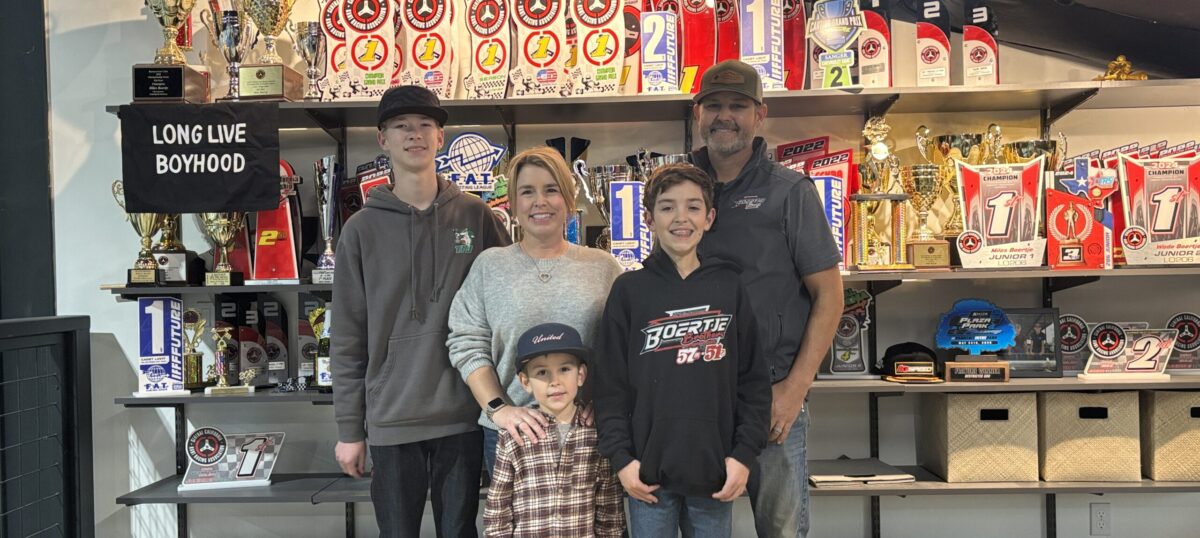
Photo by Ben Hensley | The Boertje brothers first entered the racing scene in the mid 2010s and has since traveled across the state and country, chasing dreams — and competition — through the ranks of the up-and-coming racing world. Pictured from left to right: Wade, Robyn, Reid (front), Miles and Eddy.
Written by Ben Hensley
On the track, the Boertje brothers race flat-out. Off the track, their family manages sponsorship decks, equipment depreciation, sunk costs and marketing like any small, family-owned business trying to scale.
For many drivers, racing is pure adrenaline. For the Boertjes — a Visalia family balancing asphalt, dirt and sprint cars — it’s also spreadsheets, travel budgets, sponsorship strategy and return on investment.
The boys, Wade (15) and Miles (12), entered racing the way many families do: tinkering, test-driving and competing for fun. What started as their father Eddy’s childhood dream has shifted to reality. As a child, Eddy raced three-wheelers and dirt bikes with friends; however, after “too many injuries” on dirt bikes, Eddy decided to invest in a slightly safer option, providing the same level of competition without potential hospital bills.
From horse trailer to front of the pack
Their first investment wasn’t glamorous, but started as many new racing families did — purchasing two used go karts from a Clovis family whose two-sister team (complete with matching pink and purple karts) were moving away from karting.
Appearing at their first event in a horse trailer, the family quickly drew attention.
By the end of their first weekends behind the wheel, though, everyone was talking about the kids’ performance — running up front all weekend and silencing any questions or pre-conceived judgements about their skill.
The family cycled through equipment quickly, selling off championship-winning karts at season’s end and reinvesting annually in new gear.
The duo’s success in karting quickly opened doors to other racing leagues — dirt, outlaw karts, micros — where the boys proved they could adapt across different surfaces and different race classes.
Building adaptable drivers, not just fast ones
The pair has cycled through a wide range of equipment, from asphalt karts topping 65mph to electric indoor karts running closer to 60 on tighter tracks. Dirt and outlaw karts and Micro 600 restricted cars can achieve similar speeds, while Legends and late models push the limit, closing in on 80-plus mph, depending on class and track.
“If you try different racing, you try K1 indoor, you try dirt, you try asphalt… that makes you mentally have to be adaptable,” said Robyn, the boys’ mom, adding that the mindset isn’t just about car control — it’s about drivers treating unknowns as opportunities rather than fear.
That philosophy led to an intentionally broad calendar, meaning, in a typical season, they may run asphalt karts, dirt outlaw karts and micros throughout the state — even traveling to Tulsa, Oklahoma to compete in sprint cars.
A different kind of ladder: the K1 Speed Championships
That exposure-first mindset also positions the boys for events like K1 Speed’s California State Championship, scheduled at the end of the month in Irvine. The event draws drivers from all 15 of K1 Speed’s locations throughout the state, putting indoor electric kart racing into a statewide bracket.
One of those K1 Speed locations is at the Sierra Vista Mall in Clovis.
Podium finishers from state earn a chance to compete in the National Championship at K1 Circuit Winchester in Riverside County, with a national podium earning a ticket to the E-World Championship, featuring drivers from ten countries and a combined prize pool of $79,000.
Chasing the long shot
The opportunity is one of the highest-paying competitions available for the boys to compete in. Miles competed last year, placing runner-up in Junior US and World events last year.
For other junior drivers building résumés without burning through engines and tires every weekend, karting has become a legitimate pathway — and one the boys are aiming for.
Both boys would love to go pro — whether that path leads to sprint cars, NASCAR, Formula 1 or other sports cars. But with that in mind, both boys are also very realistic about the odds.
“That’s a long shot because a lot of kids are into that right now… but I think me and my brother do have a shot at being something professional,” Miles said.
His brother Wade, meanwhile, points to role models as helping to drive the commitment and motivation backing their behind-the-wheel journey.
“Kyle Larson — he gets in a car and he can win it,” Wade said. “Like, the first time he’s ever driven that car, he could sit in it and win it.”
If the boys focus on adaptability, their parents focus on sustainability. That means balancing time, cost, education and opportunity — without falling into one of the financial traps that stall many promising young racers.
Racing on a budget — and a balance sheet
The biggest variable is funding. Tulsa alone presented a multi-thousand-dollar week factoring in travel, lodging, mechanics, entry fees, tires and equipment transport. The family combines sponsorship help, strategic timing and business credit card points from their family-owned cattle business — Boertje Cattle — to help fund the hobby.
Sponsors aren’t just decals and decorations — they’re part of the business model. The family writes letters, nurtures business relationships and treats supporters like partners. As a racing business, they understand ROI goes both ways.
“Return on investment is hard, because in racing… [in Tulsa] there’s over 2,000 people racing there. There’s five winners,” said Robyn, who handles much of the marketing and financials.
As the boys moved into larger dirt cars, the family also recognized that added space and bigger body panels equal more billboard space. Eddy said it was an interesting adjustment when companies asked the cost to get their name on the car, and having to answer like a businessman, not a hobbyist.
More than a scoreboard
Not every return for the family is measured in cash. Racing has become the family’s version of weekend camping, extended road trips, shared goals and mutual success and heartbreak. The boys wrench on the cars, work on the ranch and are expected to keep up academically. Success or failure on the track doesn’t exempt them from everyday life.
Robyn, who grew up playing various sports, believes that’s its own reward.
“You learn a lot in any sport, and it’s one where you learn life skills and the ins and outs of life,” she said. “The heartbreaks of life; the good parts of life. It’s good.”
Building something that lasts
Still, no one in the family is naïve about where it could lead; many junior drivers’ talent level stalls in karting. Others peak in dirt. A rare few build enough momentum, money and connections to reach stock cars, sprint cars or sports car development levels. The Boertjes don’t count on any single rung — and they don’t panic if one breaks.
The family frames the journey as business and dream in equal parts, saying “win or lose, racing has done its job — teaching adaptability, composure, work ethic, resilience and budgeting.”
Whether the future leads to the next Max Verstappen or Kyle Larson or simply remains a life-long hobby and passion is yet to be determined, but in the meantime, they’ll continue doing what they love: showing up, hauling cars, writing sponsorship decks and making the math work.
For the Boertjes, racing isn’t just speed; it’s entrepreneurship — mixed with rubber, dirt and asphalt.
Related Posts
-
 Who’s driving? Fresno gig workers push for rules on driverless cars Posted: March 25, 2026 at 2:57 pm
Gig workers and labor organizers gathered at Fresno City Hall
Read more » -
 Fresno State changes its sports marketing model after decades Posted: at 2:52 pm
Fresno State Athletics announced the launch of Bulldog Sports Enterprises,
Read more » -
 Fresno staffing firm partners with EDC to place workers at no cost to employers Posted: at 12:25 pm
Denham Resources, a leading staffing and human resources consulting firm
Read more » -
 Valley Children’s new pediatric residents through national match Posted: March 24, 2026 at 3:55 pm
Valley Children’s Hospital has welcomed 14 new physicians into its
Read more »
Central Valley Biz Blogs
-

BLOG: The Central Valley — California’s manufacturing bright spot
Posted: March 13, 2026 at 2:07 pm
If you follow the headlines, you might conclude that manufacturing
Read more » -

BLOG: California’s tribal casinos trample smaller cardrooms with new regulations
Posted: March 11, 2026 at 9:18 am
While writing a book about California politics a quarter-century ago, I devoted
Read more »