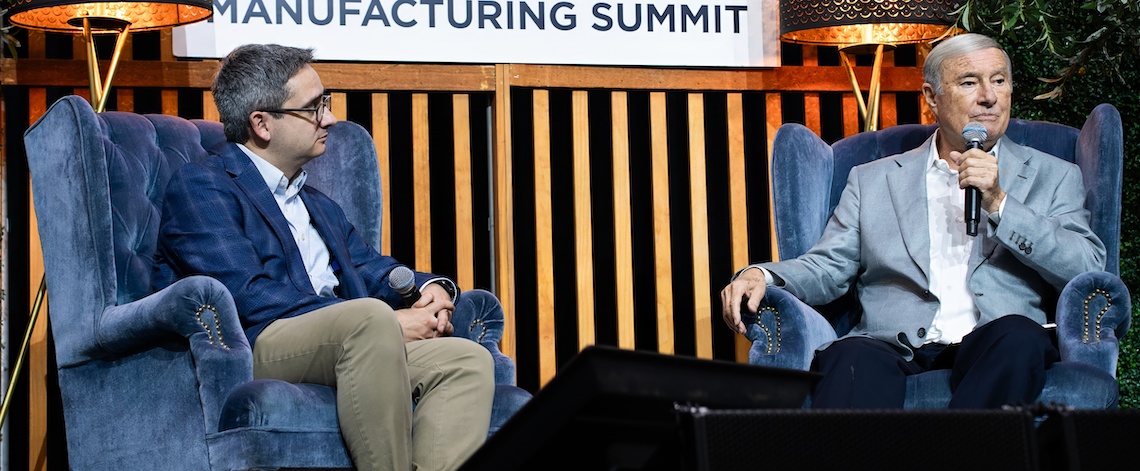
From left, Oren Cass and Pete Weber speak at the 10th annual Valley Made summit in Fresno on Oct. 29, 2025. SJVMA photo
Written by Frank Lopez
Innovation, education and collaboration were the major themes of the 10th annual “Valley Made” Manufacturing Summit hosted by the San Joaquin Valley Manufacturing Alliance.
This year’s summit celebrated a decade of industry leaders, educators, workforce partners and policymakers striving to bolster the Central Valley’s manufacturing economy.
The summit’s theme, “Forging the Future: Uniting Industry, Education, and Innovation for Manufacturing Excellence,” illustrated the role manufacturers play in securing the nation’s economic future, strengthening domestic supply chains and developing a highly skilled workforce pipeline.
Guests had the opportunity to engage in discussions, expert panels and strategic networking opportunities.
Some of the breakout sessions moderated by business leaders, educators and industry experts included “Paid Pathways to Manufacturing Careers,” “Addressing the Leadership Gap: Everyday Leadership Tools,” “Strategic Planning, Change Management, and Employee Morale” and several others.
SJVMA CEO Genelle Taylor Kumpe said local manufacturers, educators, workforce organizations and business leaders are all united by a shared commitment to industry and the region’s success.
“Manufacturers, educators and innovators are working side by side to create a stronger, more connected workforce pipeline across the Central Valley—one that supports business growth and creates opportunity for people and our community,” Kumpe said.
This year’s keynote speaker was Oren Cass, founder and chief economist of American Compass, a think tank, and author of “The Once and Future Worker: A Vision for the Renewal of Work in America.”
He is also a contributing opinion writer for the Financial Times and The New York Times.
During his keynote address, moderated by local entrepreneur Pete Weber, he explored the strategic importance of domestic manufacturing, the need for stronger partnerships between industry, education and government, and why workforce development and alternative career pathways must be prioritized.
Along with highlighting the natural beauty of the Central Valley region, Cass said the manufacturing workforce and career technical education stood out to him, as well as the spirit of collaboration between industry and education.
“That is something that nationwide has become popular to talk about, but you still see very little action,” Cass said. “You have everybody not just doing their part, but forming a Venn diagram with everybody overlapping and trying to help in other areas. It produces a really unique dynamic that I haven’t seen in many places.”
This has resulted in producing an available workforce that is supporting businesses in the area.
Fresno Mayor Jerry Dyer noted that California leads the nation in manufacturing, with no other state even coming close.
“The strength that keeps California on top, the power behind its success comes from right here in the Central Valley,” Dyer said. “While other regions are talking about challenges, we are figuring out a path to fuel this economic engine. While others slow down, in Fresno, we double down.”
Jobs are growing, businesses are expanding and investment is pouring in—that’s the spirit of the Valley—ingenuity and brilliance, he added.
The summit closed with Fresno First Bank Power Hour, allowing attendees to reflect and reconnect, and designed as a high-impact networking experience for business-to-business exchange, collaborative conversation and curated engagement opportunities.
Related Posts
-
 Tesla ‘T’ sign, construction activity point to expansion at former Fresno Lexus site Posted: April 29, 2026 at 3:16 pm
A large Tesla "T" sign and a flurry of construction
Read more » -
 After record ‘Hadestown’ run, Broadway report shows Fresno’s $10M economic boost Posted: April 28, 2026 at 10:37 pm
Broadway touring productions generated nearly $10 million in economic activity
Read more » -
 Citizens Business Bank tops $20B in assets after Heritage merger Posted: at 10:17 pm
CVB Financial Corp. has completed a merger with Heritage Commerce
Read more » -
 Fresno man sentenced in $5M canola theft scheme Posted: at 10:04 pm
Richard Best, 72, of Fresno, was sentenced Monday by the
Read more »
Central Valley Biz Blogs
-

BLOG: Two decades in, I’m still learning from this community
Posted: at 12:44 pm
I’m so grateful for all of the people who went
Read more » -

BLOG: JPMorgan, BNY Mellon roll out deposit tokens, lobby to restrict non-bank stablecoins
Posted: April 27, 2026 at 1:35 pm
While the Clarity Act remains stalled in Congress over the
Read more »