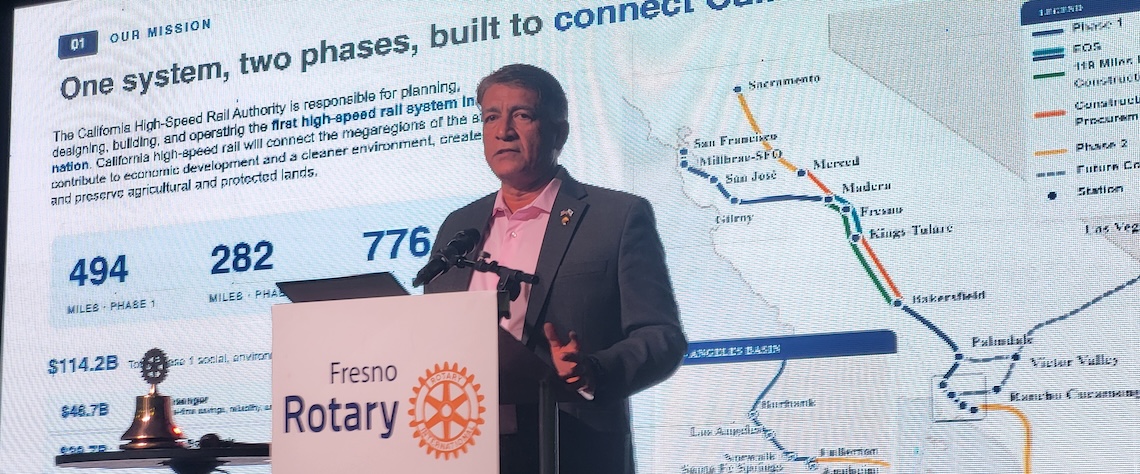
California High-Speed Rail Authority CEO Ian Choudri addresses the Fresno Rotary Club on Monday, Aug. 17, 2026. Photo by Gabriel Dillard
Written by Gabriel Dillard
California High-Speed Rail Authority CEO Ian Choudri brought his pitch for the nation’s first true high-speed rail system to the Fresno Rotary Club on Monday, laying out a timeline for track installation, testing and eventual service while acknowledging a multibillion-dollar funding gap that could send the Authority back to state lawmakers.
Here are five things to know from his remarks.
1. Track installation is set to begin this year
Choudri said the Authority plans to begin laying track toward the end of this year along the 119-mile stretch under active construction in the Central Valley. Overhead wires to power the trains will be installed alongside the track, he said. A consortium of Kiewit, Stacy and Witbeck and Herzog will handle the 25-kilovolt AC track and systems installation, and the first materials are expected to arrive by rail at a staging facility in Wasco in November.
Choudri reports that 61 major structures are now complete across the first 119 miles, at 71% completion.
2. Trains could start testing by 2029 and carry passengers by the early 2030s
Choudri said train testing is planned for 2029 to 2030, with passenger service targeted for 2032 to 2033. Siemens and Alstom are providing the rolling stock, he said. The trains are designed for a top speed of 220 mph, faster than the 180-to-200-mph top speeds Choudri said are common in Europe, though he noted a train needs roughly 11 to 12 miles to reach full speed and another 12 to slow down, so actual speeds will depend on the distance between stops.
That timeline is more optimistic than a recent assessment from the Authority’s inspector general. An Aug. 11 review by Inspector General Ben Belnap found the project’s schedule could slip to as late as September 2034 and warned the Authority could exhaust its funding by December 2027 without new financing. The same reporting found the Authority recently cut its initial trainset order from six to three.
3. Fresno has the edge for a major maintenance hub
The Authority is weighing two sites — one in Fresno and one in Kings County near Hanford — for its proposed Central Valley Heavy Maintenance Facility, which would service the train fleet and, at full buildout, employ an estimated 1,700 to 2,100 workers. Choudri signaled where the Authority may lean.
“Fresno is more favorable for a lot of reasons,” he said.
A public comment period on the site runs through Sept. 14, with public meetings scheduled in Fresno, Hanford and online.
4. The Authority is courting private money — and facing a shortfall
Choudri said the Authority is turning to private development groups to invest and build alongside the project, drawing interest from three or four major developers and signing a deal with one so far. In June, the Authority executed a co-development agreement with Momentum Alliance Partners, a global consortium that Choudri said represents pension funds from around the world.
The Authority is also expected to select a partner this month under its CalClean initiative to invest in green energy, with an agreement execution targeted for September, Choudri said. The partner has not been named.
Even so, Choudri acknowledged a shortfall of nearly $10 billion and said the Authority might have to return to the Legislature and the administration for more money.
5. Choudri says the scope and speed make it one of a kind
Choudri framed the project as unlike anything attempted in the country, citing its scale and 220-mph design speed.
“This is a true high-speed rail system that has never been within the U.S.,” he said.
He put the full cost at roughly $130 billion, above the Authority’s own $126.1 billion estimate in its 2026 business plan, and said ticket prices would be standardized, similar to high-speed systems elsewhere in the world. To help cover costs, the Authority’s co-development partner could pursue ancillary revenue including fiber-optic and broadband leasing along the corridor and development on state-owned property.
Related Posts
-
 From fairgrounds to hotels, Valley meeting venues offer room to gather Posted: August 20, 2026 at 2:30 pm
The Central San Joaquin Valley has more meeting and event
Read more » -
 5 things to know from high-speed rail CEO’s Fresno visit Posted: at 2:08 pm
California High-Speed Rail Authority CEO Ian Choudri brought his pitch
Read more » -
 Amazon opens third Visalia distribution hub, adding 600 jobs Posted: at 11:37 am
Amazon confirmed this week that its third Visalia distribution hub
Read more » -
 New color rules take effect for Madera commercial properties Posted: at 11:17 am
New exterior color standards are now in effect for commercial
Read more »
Central Valley Biz Blogs
-

BLOG: 140 years, five generations, one mission
Posted: August 19, 2026 at 3:30 pm
There are very few moments in a company’s history that
Read more » -

BLOG: Spending money is emotional — the missing piece of financial literacy
Posted: August 18, 2026 at 2:47 pm
I can spend hours teaching someone financial concepts, helping them
Read more »