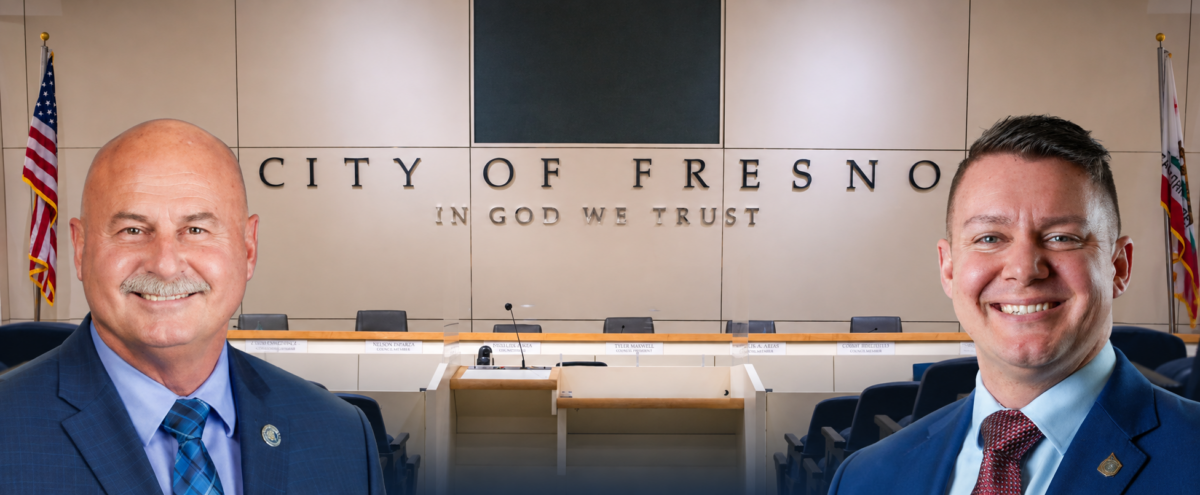
From left: Fresno Mayor Jerry Dyer and City Councilmember Nick Richardson are co-sponsoring a data center resolution before the City Council Thursday. Photo illustration/The Business Journal
Written by Ben Hensley
A proposal to prohibit data centers in Fresno goes before the Fresno City Council Thursday. Mayor Jerry Dyer, a co-sponsor of the measure by Fresno City Councilmember Nick Richardson, said in a statement Wednesday that he opposes data center development in Fresno “under current technologies.”
The proposal would not permanently close Fresno to future data centers. Richardson said interested operators may currently seek authorization through the city’s planning process, while a future city council could amend or repeal any prohibition ultimately adopted.
“It’s not a response to any particular data center or AI,” Richardson said Tuesday.
Instead, Richardson said the measure is intended to make an existing land-use barrier explicit rather than create an entirely new one.
Where Mayor Dyer stands
Dyer said his opposition reaffirms a “previous determination” that data centers are not an appropriate land use for Fresno and are not allowed within city limits. His statement cited recent speculation about potential data center projects, particularly in the Southeast Development Area (SEDA).
Data centers are not permitted anywhere in Fresno under the current development code, according to Dyer’s statement. Pending approval of the SEDA Specific Plan, the next step would include adopting a new development code for that area, and city staff is already drafting that code to prohibit data centers there as well.
Dyer said he spent the past year attending presentations on data centers and speaking with mayors of communities where the facilities have been built, describing those conversations as insight into both the opportunities and the challenges the projects present.
As they traditionally operate, Dyer’s statement said, data centers are large-scale facilities running high-powered servers for AI model training, high-performance computing, data mining, cryptocurrency validation and cloud storage. They require extremely high electricity and water usage, substantial cooling systems and generate constant mechanical noise for surrounding communities, though emerging technology may reduce some of those impacts over time.
Data centers can also occupy significant amounts of land while creating relatively few permanent jobs compared with other potential uses, according to the statement.
“I want to see land in Fresno, especially within South SEDA, used to create additional housing and good-paying jobs in industries such as advanced manufacturing,” Dyer said. “We must make thoughtful decisions about how we use our limited land, water, and energy resources, and those decisions must provide the greatest possible benefit to Fresno residents.”
What the resolution would do
Thursday’s resolution would not itself establish a ban. It would direct city staff to draft an amendment to Fresno’s Development Code containing a clear definition of data centers and an explicit citywide prohibition.
“We’re not going to change anything with this,” Richardson said.
Richardson argued the amendment would formalize a restriction he believes already exists in practice.
The resolution states the definition “shall include, but not be limited to, specialized facilities designed to house the specific IT infrastructure needed to train, deploy, and deliver Artificial Intelligence (AI) applications and services.” Because the full definition remains unwritten, the precise boundaries of what would qualify as a data center would be determined during the amendment process.
The prohibition would initially last 10 years, then become permanent unless amended by a future council vote.
The amendment would undergo an environmental assessment under the California Environmental Quality Act before going to the Airport Land Use Commission, Planning Commission and ultimately returning to the City Council for final consideration.
Why 10 years
Richardson said the decade-long window is intended to let future councils reconsider the policy if technology advances and facilities become less resource-intensive or generate more employment.
“Maybe we get to a point in the future where, you know, these data processing centers are smaller and consume less water and provide more jobs per acre and or something that the city of Fresno wants to take a look at,” Richardson said.
What it means for businesses
Richardson said the measure is not intended to signal that Fresno is closed to business.
“I’ve kind of developed a reputation on the council of pushing back against anything that tells any person or industry, business owner or otherwise, that Fresno doesn’t want you here,” Richardson said.
The definition would focus on sites primarily used for data processing, not hospitals, distribution centers or other businesses operating data infrastructure as part of broader operations.
“This ordinance, rather, is meant to curtail the growth or spread of places whose primary purpose is the storage and computation of data,” Richardson said.
The amendment would undergo an environmental assessment under the California Environmental Quality Act before going to the Airport Land Use Commission, Planning Commission and ultimately returning to the City Council for final consideration.
Related Posts
-
 BBB accepting applications for inaugural Fresno business accelerator cohort Posted: September 2, 2026 at 2:40 pm
The Better Business Bureau (BBB) is currently accepting applications for
Read more » -
 Fresno Falcons’ Jimmy Fries talks business behind team’s return to Downtown Fresno Posted: at 1:59 pm
The Fresno Falcons are preparing for their return to professional
Read more » -
 Mayor Dyer joins Richardson to formalize Fresno’s data center ban Posted: at 1:35 pm
A proposal to prohibit data centers in Fresno goes before
Read more » -
 Fresno Public Works Director Scott Mozier to retire, successor named Posted: at 1:07 pm
Brian Russell, a City of Fresno employee since 1994, will
Read more »
Central Valley Biz Blogs
-
OPINION: Fresno County should stop leaving visitor revenue on the table
Posted: September 1, 2026 at 3:19 pm
As Fresno County Assessor-Recorder, I spend a great deal of
Read more » -

OPINION: Who do you trust on SEDA?
Posted: August 31, 2026 at 3:45 pm
There are many voices weighing in on the SEDA (Southeast
Read more »