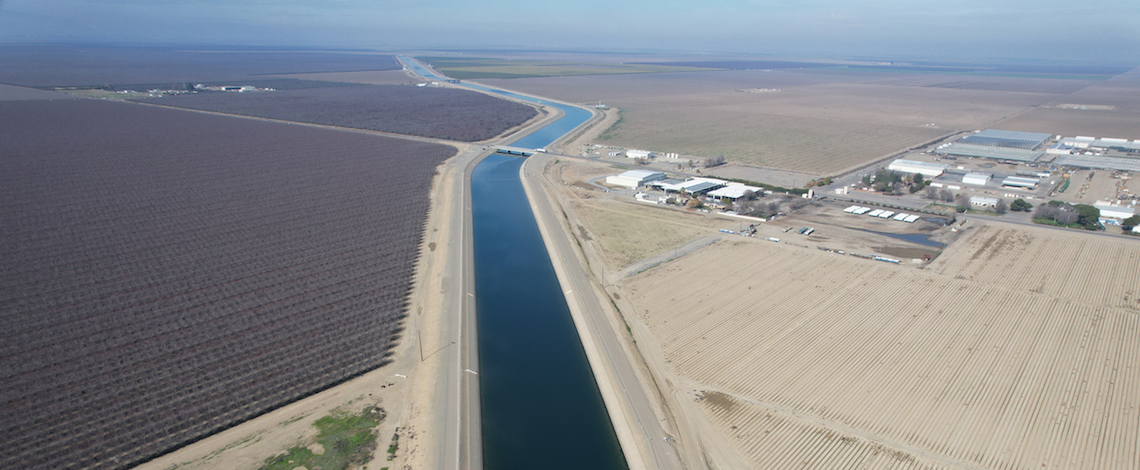
The California Aqueduct, part of the State Water Project, is seen in this aerial photo by the Fresno County Sheriff's Office.
Written by Jeff Macon
For much of California’s agricultural history, a wet winter brought relief. Reservoirs filled, rivers ran high, and growers assumed surface water deliveries would follow. Today, that assumption no longer holds. Even in years marked by heavy storms and strong reservoir storage, California water allocation anxiety persists.
The disconnect reflects a fundamental shift in water management. California’s system is now governed as much by regulation, environmental constraints, groundwater limits and operational rules as by precipitation totals. In short, flood years no longer guarantee reliable water.
Early numbers signal uncertainty
The 2026 water year opened with a familiar signal of uncertainty. On Dec. 1, the California Department of Water Resources (DWR) announced an initial State Water Project (SWP) allocation of 10 percent. DWR stressed that early allocations are conservative by design and may rise as winter unfolds. But for growers and water-dependent businesses, the initial number still matters because timing matters. “Maybe later” water does not reopen planting windows, rehire laid-off workers or restore fallowed acreage.
On April 1, DWR announced no measurable snow at its survey locations in the Sierra Nevada.
Ryan Endean, DWR’s deputy director of communications, said the initial allocation is not intended to track headlines about whether California is “drought-free.” It is an early season forecast based on current hydrology, reservoir levels and an assumption of dry conditions ahead. The U.S. Drought Monitor, he noted, is not used by DWR as an indicator for SWP allocations. Instead, DWR updates the allocation forecast as conditions change through the winter, with final allocations set in late spring. The practical implication, Endean said, is that uncertainty is baked in until the season’s precipitation and snowpack are clearer: “Every day it doesn’t rain or snow, our snowpack and precipitation averages drop,” and that ultimately affects supply.
At the federal level, volatility has become routine as well. Central Valley Project (CVP) agricultural contractors received an initial allocation of 35 percent last season — an improvement over prior lows, but still emblematic of a system that struggles to deliver predictable supply.
A structural storage mismatch
So why does uncertainty persist even when water appears abundant? The answer is a structural mismatch between when water arrives and when the system can store or use it.
During major storm events, California regularly releases large volumes of water to protect dam safety and downstream communities. That is a public safety obligation. Yet the ability to capture flood flows — either in reservoirs or through groundwater recharge — is constrained by physical capacity, conveyance bottlenecks, permitting and water-rights requirements and operational rules intended to protect ecosystems and manage flood risk.
Recharge isn’t an easy fix
Sarge Green, a project director with Fresno State’s California Water Institute and former general manager of the Tranquillity Irrigation District, said recharge during flood events is often misunderstood as an easy fix. In practice, recharge depends on percolation rates and geology, and the best locations are limited. Floodwater naturally moves to low-lying areas that often have poor permeability, so capturing it frequently requires redirecting flows to better soils — work that depends on infrastructure and coordination among landowners, districts, and agencies.
“By definition, floodwater occurs when reservoirs are full, and distribution systems are already at capacity,” Green said. “At that point, much of the water has to move downriver through flood channels.”
Climate change shifts the calculus
Climate change is intensifying the challenge. Green noted that California is increasingly receiving heavier rainfall instead of snowpack. Historically, snowpack functioned as the state’s largest and most flexible storage system because it melts gradually through spring, allowing reservoirs to be filled, drawn down and refilled. When more precipitation arrives as rain, more water comes in short bursts — harder to store, harder to move and easier to lose through flood releases. This season illustrates the new paradigm: reservoirs can look strong while snowpack remains weak, raising risk for later allocations.
SGMA closes the backstop
Groundwater limits add another permanent constraint. The Sustainable Groundwater Management Act (SGMA), enacted in 2014, requires basins to reach long-term sustainability by the early 2040s. In overdrafted regions, that means pumping reductions. Groundwater, once the backstop during surface shortages, can no longer simply “fill the gap” without worsening overdraft and subsidence.
Jennifer Pierre, general manager of the State Water Contractors, said California’s infrastructure and regulatory framework were built for seasons that were either mostly wet or mostly dry. “That is no longer the case,” she said. Pierre argued that while operating rules should better reflect real-time conditions, the most consequential improvements for SWP reliability require infrastructure — specifically the Delta Conveyance Project and repairs to subsided canals.
The Valley counts the costs
The economic stakes are not abstract. Westlands Water District has warned that SGMA is narrowing the safety valve growers historically relied on when surface supplies fell short. In its 2025 Economic Impact Report, Westlands said growers must reduce groundwater use from about 603,000 acre-feet in 2022 to roughly 305,000 acre-feet by 2030. The report links consecutive years of zero federal allocation to steep regional impacts: a roughly 25 percent decline in economic activity, nearly 7,500 jobs lost, and reduced local tax revenues that support schools, roads, and public safety.
Adapting to the new normal
California’s new water reality is not simply “more drought” or “more floods.” It is greater volatility colliding with infrastructure and rules that cannot always pivot fast enough to capture water when it arrives. For Central Valley businesses, farmers, and communities, the challenge is adapting to a system where even flood years do not guarantee water security — and whether policy, infrastructure and coordination can evolve quickly enough to match the new normal.
Related Posts
-
 California grape season starting early, giving retailers a head start on promotions Posted: April 20, 2026 at 4:54 pm
California's table grape season is arriving earlier than usual in
Read more » -
 Paradox of Plenty: Why California can be wet and still short on water Posted: at 4:36 pm
For much of California's agricultural history, a wet winter brought
Read more » -
 Already under financial pressure, Midwest soybean farmers are squeezed further by tariffs, Iran war Posted: April 13, 2026 at 5:26 pm
(AP) — Strong winds whipped around Doug Bartek, a fifth-generation
Read more » -
 FPU partners with F3 to launch ag leadership certificate Posted: at 5:10 pm
Central Valley residents can pursue leadership development in agriculture through
Read more »
Central Valley Biz Blogs
-

BLOG: Why beneficiary reviews are a must — not a maybe
Posted: at 2:11 pm
When it comes to financial planning, many people assume that
Read more » -

BLOG: Finding a future in machining
Posted: at 1:46 pm
Editor’s note: This is part of an employee spotlight series
Read more »