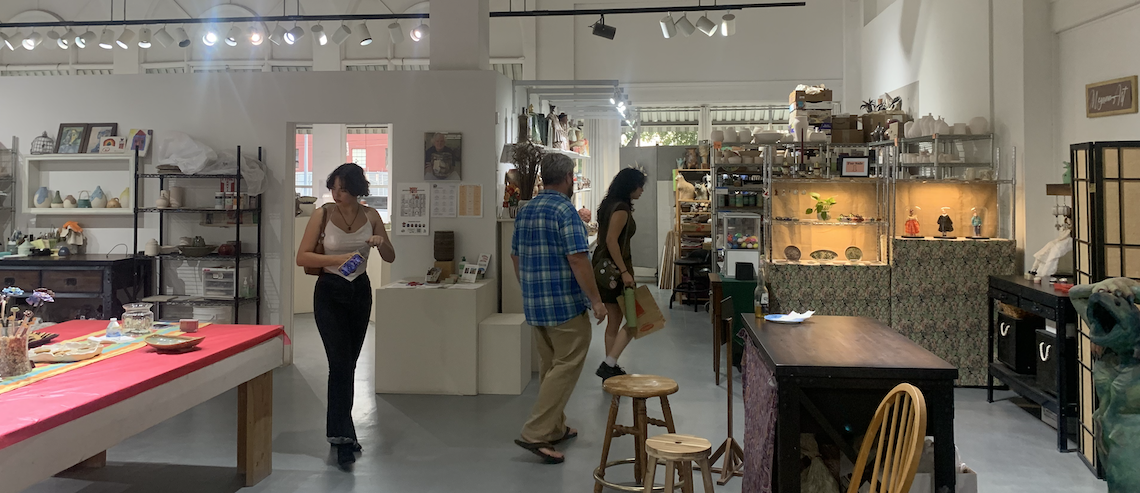
Visitors browse the art at the Fig Tree Gallery during a pared down ArtHop event Aug. 1. Photo by Frank Lopez
Written by Frank Lopez
Downtown Fresno didn’t see its typical bustling crowds Thursday evening during ArtHop after the city’s ban on outdoor vendors.
In late July, Fresno City Councilmember Miguel Arias announced that the city would not allow outdoor vendors for the Aug. 2 Fresno ArtHop.
Arias said the limits for the popular event come from concerns regarding public safety and excessive heat. He said the city will plan to require permits for vendors for the next ArtHop. Arias and Mayor Jerry Dyer also plan to host the street fair on Wednesdays, splitting it from the traditional Thursday gallery event.
Some vendors did attempt to set up pop-up tents on Fulton street, but code enforcement quickly shut them down.
Some local businesses did allow vendors to set up in inside their indoor locations.
Local artists and vendors planned on social media to resist the ordinance and set up outside, including at Kern Plaza. A handful could be seen operating.
At an informational forum at Fresno City Hall on Wednesday, Arias announced plans to split the event, with vendors welcomed on Wednesdays when more police officers are available to work.
He said the city could cover the cost of closing the street for vendors to set up their booths, as well as for public restrooms, garbage services, and patrol.
Vendors would be required to pay for a $24 business permit and food vendors will have to pay for a public health permit from Fresno County.
Armando Aragon, a vintage clothing vendor, said on social media that the Fresno Arts Council is trying to make the event into an “elitist gallery only event.” He said his profit was a third of what a normal ArtHop event would bring.

“The city essentially ruined a great event to please property developers and the fat cats that want to get their hands in the cookie jar when they see the common man coming up too much for their liking,” Aragon said.
Lilia Gonzales-Chavez, executive director of the Fresno Arts Council, said the in the last 15 years more people began showing up for Art Hop, but outside of the venues and displaying their work in the street.
After ArtHop re-opened due to being shutdown because of the Covid-19 pandemic, “it came back with a vengeance,” she said.
After Covid-19, she said a state law allowed licensed vendors to sell anywhere in public as long as the area was not closed for a special event.
“Some folks just don’t know how to behave and now we have a situation that is dangerous,” Gonzales-Chavez said. “We saw it coming.”
She the council encouraged the health department to make sure food vendors had their licenses, and for the police to patrol.
“It kept growing and we couldn’t control it,” Gonzales-Chavez said.
Arias noted that ArtHop is separate from the outside vendors, which he called “essentially a street fair.”
He said that the event can draw up to 15,000 people each month.
Sharon Alexander is a local artist with space in the Downtown Artist Gallery. She said they have a crowd of regulars but did notice less people coming with the ban on outdoor vendors.
She along with other her husband, David and other artists, formed ArtHop in the early 1990s.
Alexander said the popularity of ArtHop is a positive thing for the area.
“People were telling me that people might have gotten confused and were thinking all of ArtHop was affected by the decision,” Alexander said. “The more energy downtown gets, the better. It’s a chance for young businesses to get going and for kids to come out and show art.”
Robert Ogata, a painter and one of the founders of ArtHop, said the event has made people feel more comfortable visiting downtown over the years.
He said that the food trucks and vendors have distracted people from the art and art galleries, and it’s become more of a “social activity.”
“There’s a change that’s been taking place,” he said.
Related Posts
-
 There’s a secret bar behind the bookcase at Fresno’s newest spot Posted: April 4, 2026 at 8:52 pm
After seven years of planning, a 110-year-old Little Armenia home
Read more » -
 Meat Market marks 50 years serving Central Valley protein needs Posted: April 3, 2026 at 4:41 pm
One of Fresno's oldest family-owned butcher shops is celebrating a
Read more » -
 New lease hints at expansion for prolific Fresno restaurant group Posted: at 4:30 pm
Fresno restaurateur David Rasavong may have another dining concept in
Read more » -
 Artemis II’s moonbound astronauts capture Earth’s brilliant blue beauty as they leave it behind Posted: at 2:55 pm
The Artemis II astronauts have captured our blue planet’s brilliant
Read more »
Central Valley Biz Blogs
-

BLOG: Half of Americans can’t cover a $1,000 emergency. Here’s how employers can help
Posted: March 31, 2026 at 3:19 pm
In today’s economy, it’s more important than ever for employers
Read more » -

BLOG: Patients are often left ‘out of network’ as hospitals, insurers clash over cost
Posted: at 2:42 pm
This commentary was originally published by CalMatters. Sign up for their newsletters. No
Read more »