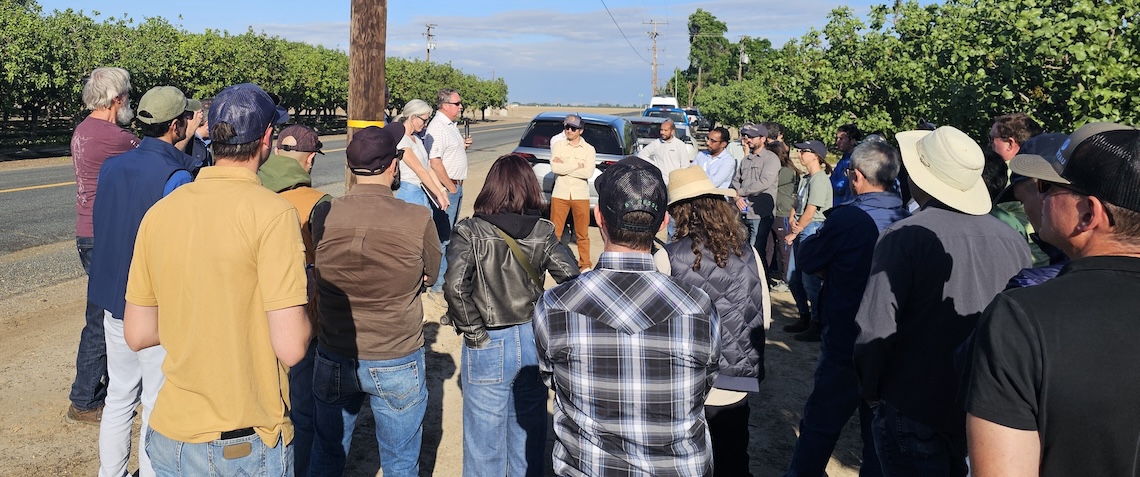
Irrigation specialists from Mexico, Argentina, Chile and Italy joined Central Valley growers and researchers for an in-field visit at Nichols Farms in Hanford as part of the 2026 Advanced School on Microirrigation for Crop Production. HotSpot AG photo
Written by Frank Lopez
A Hanford company that helps Central Valley growers manage their farms through automation recently drew irrigation specialists from four countries for a firsthand look at how technology is reshaping water and fertilizer management in American agriculture.
HotSpot AG, based in Hanford, hosted specialists from Mexico, Argentina, Chile and Italy in early April as part of the 2026 Advanced School on Microirrigation for Crop Production. Attendees visited HotSpot’s training center and nearby Nichols Farms for sessions on automation and fertigation in action — bridging classroom strategy with real field operations across pumps, valves and irrigation systems.
Spreading roots
The company is run by James Nichols, a fourth-generation farmer and president who also serves as vice president of farm operations at Nichols Farms, a fourth-generation pistachio grower and processor in Hanford. HotSpot AG retrofits legacy irrigation equipment, giving growers a remotely operated pump station, automation-ready valves, engine stations and sensors. Since its first commercial installation in 2019, the company has grown to more than 600 users across California and other states.
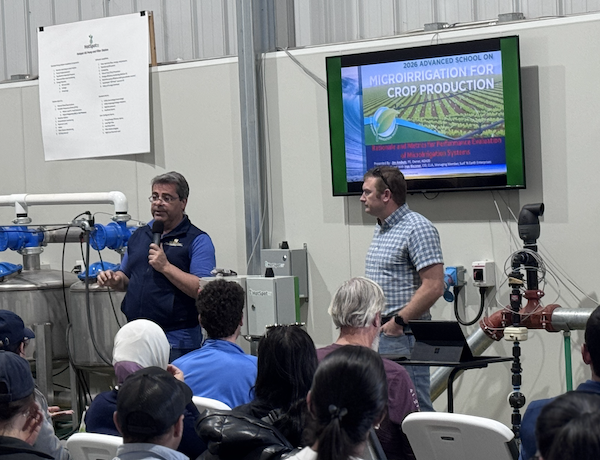
The company also produces fertigation skids — preassembled units that combine fertilizer injectors, pumps, valves and controllers into a single system. The technology injects nutrients, acid or chemicals directly into irrigation lines for more precise delivery to plant roots, improving fertilizer efficiency, reducing labor costs and boosting crop yields.
Nichols shared practical insights and real-world success stories with visiting specialists, demonstrating how automation is being used to improve system performance and decision-making.
Partnerships yield results
Daniele Zaccaria, a UC Davis professor of Agricultural Water Management and one of the microirrigation school’s organizers, also attended.
“The major goal is to provide more accurate information on micro-irrigated crops that can help farmers, crop advisors, orchard managers and vineyard managers in putting together irrigation scheduling and optimizing labor, water and energy,” Zaccaria said.
Beyond water conservation, he said the broader goal is maintaining or increasing production while using fewer resources across the board.
Zaccaria said partnerships between agriculture companies and research institutions produce measurable, practical results.
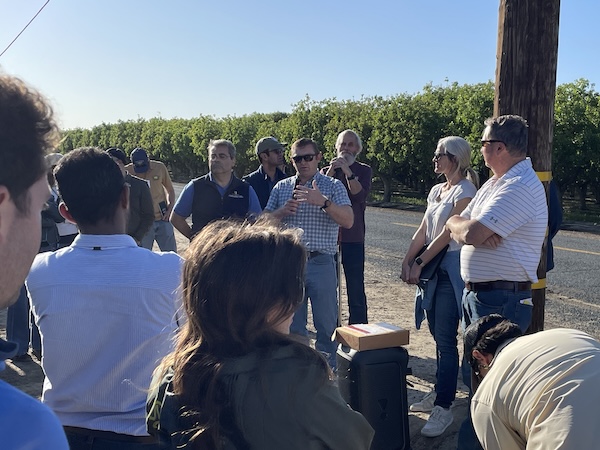
James Nichols, president of HotSpot AG and vice president of farm operations at Nichols Farms, addresses international attendees during a field session demonstrating how automation and fertigation technology are being applied in real Central Valley operations. HotSpot AG photo
“Researchers can be in their own bubble and sometimes that bubble has to burst,” he said. “We have to land on the real production side. This is a real example of proactive collaboration from both the production side and the educational side.”
Global conflicts drive price
Conserving fertilizer has taken on added urgency amid recent price spikes tied to international instability, including conflicts in the Middle East and disruptions in the Strait of Hormuz — echoing a similar surge when Russia invaded Ukraine in 2022, Nichols noted.
Labor pressures are compounding the challenge. Automation allows growers to schedule fertigation at the optimal time, reducing waste without requiring around-the-clock staffing.
“It could be very costly to have someone on staff just to monitor and do injections in the middle of the night,” Nichols said.
Family legacy in ag
Resource stewardship runs deep in the Nichols family — his grandfather and company founder Graydon Nichols partnered with the UC Cooperative Extension to develop better farming practices from the beginning.
Nichols expects adoption of systems like HotSpot AG to accelerate, particularly in years of tight water supply. With 2026 bringing increased reliance on groundwater, growers will need to adapt their irrigation strategies accordingly.
Related Posts
-
 Fresno man sentenced in $5M canola theft scheme Posted: April 28, 2026 at 10:04 pm
Richard Best, 72, of Fresno, was sentenced Monday by the
Read more » -
 Inside HotSpot AG, the Central Valley firm teaching the world to farm smarter Posted: April 27, 2026 at 3:48 pm
A Hanford company that helps Central Valley growers manage their
Read more » -
 SPONSORED: Your summer in ag innovation starts here Posted: at 3:29 pm
F3 Innovate is now accepting applications for TerraTech26, a paid
Read more » -
 Nova Farming’s Rizpah Bellard bringing cattle ranching, tech and equity to Fresno schools Posted: at 3:06 pm
The day Cleveland Bellard's path toward agriculture began, he was
Read more »
Central Valley Biz Blogs
-

BLOG: Two decades in, I’m still learning from this community
Posted: April 28, 2026 at 12:44 pm
I’m so grateful for all of the people who went
Read more » -

BLOG: JPMorgan, BNY Mellon roll out deposit tokens, lobby to restrict non-bank stablecoins
Posted: April 27, 2026 at 1:35 pm
While the Clarity Act remains stalled in Congress over the
Read more »