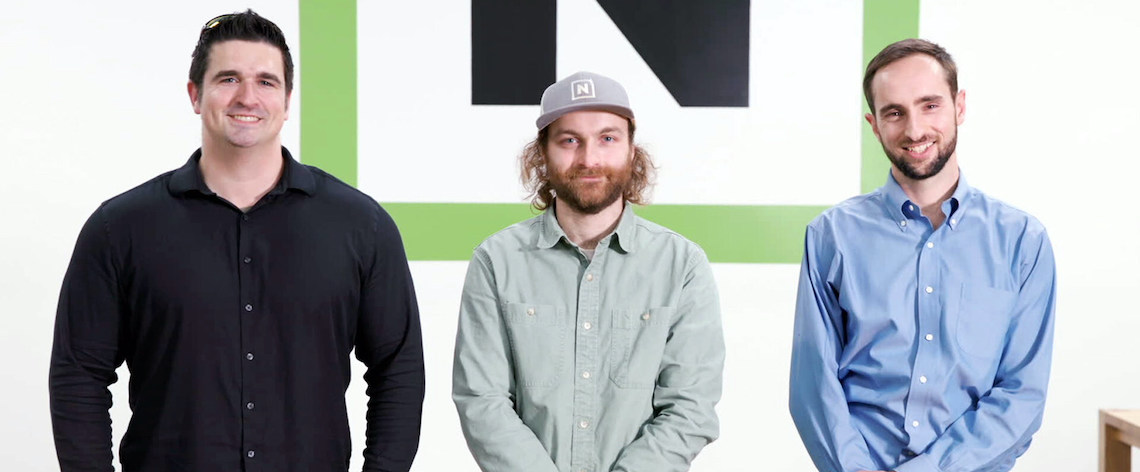
Nitricity founders Dr. Joshua McEnaney (President and CTO), Dr. Jay Schwalbe (CSO), and Dr. Nicolas Pinkowski (CEO) at the company’s office in Fremont, California. (Source: Pique Action)
Written by Jeff Macon
Nitricity, a California startup with Stanford roots and Fresno State field trials, is scaling up its effort to transform the fertilizer industry. The company has broken ground on its first full-scale production facility in the Central Valley, a milestone that ties together global climate goals and local economic development priorities.
Founded in 2018, Nitricity produces nitrogen fertilizer using air, water, and renewable electricity — eliminating the greenhouse gas emissions tied to conventional ammonia production. More recently, the company has pioneered a method to turn almond shells into organic fertilizer, converting an abundant agricultural byproduct into a valuable product for growers.
Nitricity CEO Nicolas Pinkowski says Nitricity is “proud to scale up our manufacturing capacity of a product that creates value for California growers; made locally with local ingredients.” He frames this new facility as a way to onshore production and provide a sustainable alternative that supports both farmers’ bottom lines and environmental goals.
The new facility, located in the Merced County community of Delhi, is backed by $10 million in project funding and represents a 100-fold increase in Nitricity’s production capacity. According to the company, its output is already fully sold through 2028. Earlier funding rounds have brought in investors such as Trellis Climate and Chipotle’s venture arm, alongside recognition like the Keeling Curve Prize for climate innovation.
For the Central Valley, the plant signals both economic and environmental impact. Fertilizer is a major expense for farmers and a volatile one, subject to global supply shocks. Nitricity’s process offers a local, renewable option that could help stabilize prices while lowering emissions. The product is also pathogen-free, plant-based, and certified organic by both the California Department of Food and Agriculture (CDFA) and the Organic Materials Review Institute (OMRI).
At the September 2025 groundbreaking, Pinkowski emphasized the broader vision: “We’re not just building a facility. We’re building a local supply chain, a blueprint for sustainable ag infrastructure, and a future where farmers have access to plant-based, pathogen-free fertilizer made from upcycled almond shells, air, water, and renewable energy.”
Nitricity’s ties to the Valley go back to its early days. The company joined Fresno State’s Water, Energy, and Technology (WET) Center through the Valley Ventures accelerator, where its approach quickly stood out.
“Nitricity conducted prototyping and field trials of their preliminary production system at the CIT research field in Fresno,” said Dr. Charles Hillyer, director of the Center for Irrigation Technology (CIT). “These trials helped Nitricity refine its system and tailor it to the needs of production agriculture. CIT provided research space, agriculture expertise, and general support during their trials. When we first saw Nitricity at Valley Ventures, it was apparent that they had a novel technology with the potential to be carbon neutral.”
Those trials gave the company firsthand insight into how Central Valley growers might use its product in the field, laying the groundwork for the commercial-scale facility now under construction.
Beyond the environmental gains, Nitricity’s almond-shell pathway highlights the promise of the Valley’s emerging circular bioeconomy. By converting agricultural byproducts into high-value fertilizer, the company is building a model where waste streams become raw materials.
“Nitricity’s growth in the North San Joaquin Valley fits right in with our region’s economic development priorities and our community’s efforts to attract and grow circular bioeconomy businesses,” said Karen Warner, founder and CEO of Modesto-based BEAM Circular, an accelerator for companies that repurpose waste. “Nitricity is a great example of a company that benefits from our region’s abundant supply of almond shells and other ag byproducts, along with access to end customers, supportive local government partners, and collaboration opportunities with education partners like UC Merced. As our region continues to invest in innovation, workforce development, and infrastructure, we look forward to the growth of more companies like Nitricity.”
Nitricity’s new facility is already sold out through 2028, signaling strong demand for its sustainable fertilizer. For growers, the promise is not just lower emissions but also greater control over costs and supply. For the Valley, it represents jobs, infrastructure, and a role in shaping how global agriculture becomes sustainable.
As Pinkowski put it at the groundbreaking, “We’re not just building a facility. We’re building a local supply chain and a future where farmers have access to fertilizer made from California resources.”
Related Posts
-
 Federal investment to enhance San Joaquin River public access Posted: February 17, 2026 at 3:01 pm
Fresno City Council President Mike Karbassi and Rep. Jim Costa
Read more » -
 Westlands board clears path for massive Valley clean energy project Posted: February 9, 2026 at 4:43 pm
The Westlands Water District Board of Directors has certified the
Read more » -
 World Ag Expo returns to Tulare for 59th year Posted: at 3:42 pm
The world's largest annual outdoor agricultural exposition is set to
Read more » -
 RANKED: The end of the mega farm sales? Posted: February 5, 2026 at 10:39 am
The Central San Joaquin Valley's agricultural real estate market in
Read more »
Central Valley Biz Blogs
-

BLOG: For the Central Valley, policy must work in practice — not just on paper
Posted: February 18, 2026 at 2:41 pm
For the Central Valley, Sacramento is not abstract. State policy
Read more » -

BLOG: Hobby Lobby called California “off limits” — then Visalia broke sales records
Posted: February 17, 2026 at 8:22 am
When Hobby Lobby decided to open its first store in
Read more »