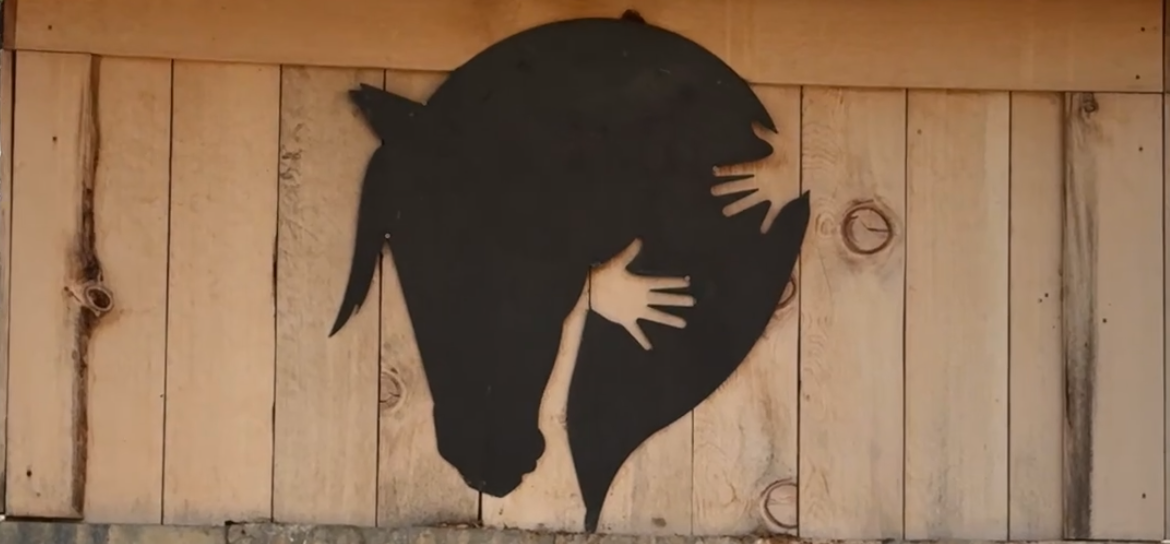
Photo by Ben Hensley | The RIDE Foundation adopted its first mustang — Monroe — in 2015, and incorporated as a nonprofit in 2017.
Written by Ben Hensley
A decade after a brainstorming-driven desire to help others blossomed into a successful local nonprofit, the RIDE Foundation aims to share the healing power of horses in its most ambitious chapter yet — one blending equine therapy, veteran reintegration and regenerative agriculture into a model that will help sustain and protect countless horses and veterans across the country.
RIDE Foundation Executive Director Sarah Muzquiz announced Saturday the launch of a national initiative, in partnership with The Hinterland Institute, aiming to train veterans in horsemanship, stockmanship and land stewardship, with a goal of transforming them into frontline stewards for Department of Defense-owned land while simultaneously supporting their emotional recovery.
“Ten years ago, I started the RIDE Foundation out of a deep desire to give others the same gift horses have given me,” Muzquiz said. “Since I was five years old, they’ve been my anchor — offering stability, strength, and healing.”
The Utah-based Hinterland Institute is a private organization that works to restore degraded Department of Defense lands through regenerative agriculture, and trains veterans in sustainable ranching. It also prepares veterans for ranching-related business ventures post-service.
The partnership, stemming from Hinterland’s SkillBridge program, will join other Department of Defense partnerships to help transition servicemembers into agricultural careers, with some members looking to stay onboard and train future ranks after their service, while others will branch out into their own ranching ventures.
“This is a mission to revitalize communities, restore land and support national resilience — led by those who have already served,” Muzquiz said.
The proposal consists of a three-phase expansion starting with the purchase of the 50-acre ranch RIDE currently operates near Reedley, as well as the construction of a year-round, covered training arena.
By the end of the third-phase, RIDE looks to train 440 veterans, with graduates moving on to maintain more than 1 million acres of U.S. Department of Defense lands across the country.
“We stand at the threshold of something extraordinary,” Muzquiz said. “We have the opportunity to elevate RIDE into a national model — one that offers Veterans a powerful path forward through a trauma-informed, immersive training program.”
Phase one of the program will aim to train 25 veterans, with that number increasing annually, eventually training more than 200 veterans annually. Each veteran will receive career training as well as emotional support. The goals also include reaching an 80 to 85% report of significant increase in emotional resilience, with goals of 70 to 75% of participants securing employment or moving on to pursue further training in the fields of agriculture and conservation.
Muzquiz said that with the U.S. facing a shortage of skilled land stewards, the skill of veterans and potential for their leadership skills and situational awareness makes them prime candidates for the field.
“The transition from military service to land management represents a natural and honorable extension of duty — moving from service to purpose,” she said.
The RIDE Foundation is seeking $3.5 million in longterm funding, with 60% funding the construction of the covered arena, and an additional 23% designated for the purchase of the 50-acre property.
The remaining funds will be used for infrastructure support and operations.
In 2023, the RIDE Foundation once again showed its ability to carry out its mission; that year alone it served 300 clients in its trauma-informed equine program, with that number rising to 450 in 2024.
Related Posts
-
 Fresno County city launches truck driving academy to meet driver shortage Posted: March 17, 2026 at 4:56 pm
The City of Orange Cove has launched a new commercial
Read more » -
 Kaiser nurses plan one-day strike over AI concerns in Fresno Posted: at 4:00 pm
Kaiser Permanente employees are planning a one-day work stoppage on
Read more » -
 $540M federal investment to revamp Central Valley water infrastructure Posted: at 3:20 pm
California's Central Valley is set to receive its largest-ever federal
Read more » -
 New SBA policy threatens financing for restaurants, construction, health care practices Posted: at 3:00 pm
Members of Congress are pushing for a reversal on new
Read more »
Central Valley Biz Blogs
-

BLOG: The Central Valley — California’s manufacturing bright spot
Posted: March 13, 2026 at 2:07 pm
If you follow the headlines, you might conclude that manufacturing
Read more » -

BLOG: California’s tribal casinos trample smaller cardrooms with new regulations
Posted: March 11, 2026 at 9:18 am
While writing a book about California politics a quarter-century ago, I devoted
Read more »