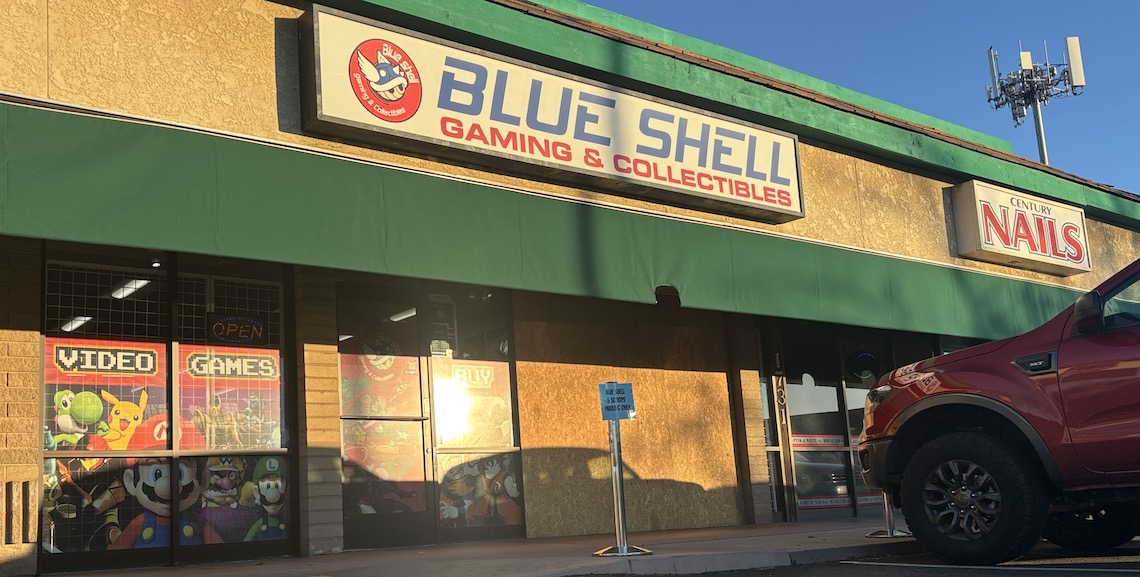
GameStop is closing four Valley locations this month as independent retailers like Blue Shell Gaming in Fresno carve out niches in collectibles and retro gaming that larger chains have struggled to fill. Photo by Ben Hensley
Written by Ben Hensley
Four GameStop locations in the Central Valley are on the chopping block this month as the struggling retailer continues to pull out of underperforming markets amid a rapidly changing gaming industry — creating opportunities for smaller, local competitors.
GameStop locations in Selma and Madera are scheduled to close this month, along with one Fresno store. A Porterville store also closed on Wednesday, Jan. 7, signaling the continued demise of the gaming store widely known as one of the most popular locations to purchase video games, collectibles and other merchandise.
The Valley closures, part of a broader national retreat for the Texas-based retailer, piled onto the nearly 600 GameStop stores that shuttered nationwide in 2024. A “significant number” of additional locations were expected to close last year, according to a 2025 Business Insider report.
GameStop operated more than 2,300 stores at the beginning of last year, down significantly from its nearly 3,000 stores just several years earlier.
The national retailer, in a filing with the Securities and Exchange Commission, said that it would continue narrowing its physical footprint, focusing on efficiency, eliminating stores in underperforming and oversaturated markets.
“We will continue to focus on cost containment, including closing underperforming stores, as we look to operate with increased efficiency,” the filing said.
From meme stock to market struggles
The company’s ongoing struggles come after a brief resurgence in the public eye. In 2021, its status as so-called internet “meme stock” provided a short-term boost, attracting retail investors to drive shares to record highs.
The collapse saw the meme stock fall dramatically, dropping to its current price of just over $20 a share.
GameStop’s core business model is under attack by a shift towards digital downloads, leaving GameStop the daunting task of shifting two business models at once — taking the plunge into physical collectibles while directly combatting cloud-based gaming.
Local retailers find their niche
Those same industry changes, however, have created space for smaller, locally-owned retailers to carve out niche roles — particularly in collectibles, retro gaming and physical media.
Rick Gonzalez, CEO of Blue Shell Gaming in Fresno, said independent stores are often better poised to adapt to shifting consumer behavior than large national chains. Gonzalez and his wife both had experience in the industry prior to opening Blue Shell Gaming in 2014, including his wife’s former work with GameStop.
Gonzalez added that the gaming industry has evolved significantly over the past decade, shifting away from the traditional model of purchasing a disc and playing a game directly from a console.
“The industry has changed from just actually buying a disk and putting in a system and playing — it has gotten more digital,” he said. “But people do want collectibles — something that’s attached to that digital game.”
The ownership question
Gonzalez said that many customers still seek out physical copies of games as a way to signify ownership in an era dominated by digital downloads. He added that digital purchases can be unstable as licensing agreements expire or platforms shut down.
“People have downloaded games, movies and digital content — and then it gets taken from them,” Gonzalez said. “When the digital store shuts down or it’s no longer licensed to a particular company, they lose that data or they can’t play it anymore.”
He added that many customers did not realize they do not technically own their purchases, but instead own permission to access licensed content.
“There are still some people that are purists and want that physical copy because it really can’t be taken away,” he said.
Agility vs. scale
Gonzalez said smaller retailers are also able to pivot more quickly than large chains when industry trends change. GameStop, founded as Babbage’s in 1984, originally focused on selling video games, consoles and accessories, only later expanding into collectibles as a revenue driver in the 2000s and more aggressively in the late 2010s.
Gonzalez said that the growing pains felt by GameStop make sense; training a national workforce is considerably more challenging than handling individual employees on a single-store level.
“It’s harder to turn that big ship,” Gonzalez said of GameStop’s shift toward collectibles. “For them to train thousands of people across their stores, it’s tougher. For us, with our smaller market, we can go teach our employees firsthand on how to value collectibles, what to look for in reproduction so that we know we’re buying the real thing, and we’re able to change our price points rather quickly.”
He added that flexibility also allows the business to extend negotiations to customers and distributors, particularly when it comes to customer trade-ins — something that can feel rigid and unfair at many large national retailers.
Gonzalez said Blue Shell Gaming plans to continue to focus on what it’s always done: prioritize physical media and offer the option of retro gaming — something many large scale retailers don’t offer — as newer consoles increase in price.
“A lot of our retro systems are still very fun to play and still very age appropriate, and our prices really haven’t changed much,” he said.
GameStop has already closed several Valley locations over the past years, including stores at the Sierra Vista Mall and Universal Park shopping center in 2015, as well as a store at Marketplace at El Paseo that only operated for a handful of years before permanently closing.
Related Posts
-
 Chilean woman pleads guilty in multistate ATM robberies Posted: February 10, 2026 at 3:53 pm
A member of a suspected South American burglary crew pleaded
Read more » -
 City blasts state inaction as care facility shuttered after 53 complaints Posted: at 3:45 pm
The Porterville City Council issued a response to the recent
Read more » -
 ‘Our Worst Fears Were Visible. They Were Known’: FBI probes $1.5M arts embezzlement Posted: at 3:23 pm
Federal and local law enforcement are investigating the alleged embezzlement
Read more » -
 Westlands board clears path for massive Valley clean energy project Posted: February 9, 2026 at 4:43 pm
The Westlands Water District Board of Directors has certified the
Read more »
Central Valley Biz Blogs
-

BLOG: How Proposition 19 (aka the ‘Death Tax’) screwed things up
Posted: February 10, 2026 at 2:55 pm
California property tax law is notoriously complex, and Proposition 19,
Read more » -

BLOG: Why B2B companies are shifting from checks to commercial cards
Posted: February 6, 2026 at 2:59 pm
In the business-to-business (B2B) world, checks have long been the
Read more »