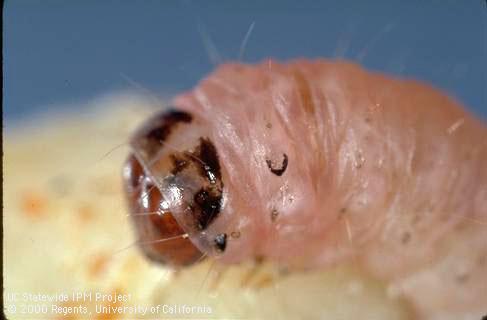
Navel orangeworm larvae have a dark, crescent-shape on each side of the second thoracic segment behind the head. Credit: Jack Kelly Clark
Written by Frank Lopez
American Pistachio Growers (APG), a nonprofit trade association based in Fresno, was recently awarded a $1 million grant from the California Department of Food and Agriculture for regional pest management collaboration set to launch in the Central Valley.
APG — in collaboration with Washington State University; University of California, Riverside; University of California Cooperative Extension, the U.S. Agricultural Research Service and regional nut industry partners — was awarded the grant through the Biologically Integrated Farming Systems Program from the California Department of Food and Agriculture to develop a Regional Integrated Pest Management network for navel orangeworm (NOW).
NOW larvae wreak havoc on the pistachios, almonds and walnuts grown in the Central Valley as they bore into nuts and consume the kernels, according to an APG news release. NOW is considered the most damaging pest in California’s tree nut industry.
The program will launch in early 2026, with pilot regions in west Fresno County and Modesto, serving as the foundation for a future statewide expansion.
The project will pilot a decision aid system that integrates real-time trap data, weather models and crop phenology into a single communication platform, with a goal to improve timing and precision, of pest control decisions while fostering regional cooperation between almond, pistachio and walnut growers.
“This is exactly the kind of innovation California agriculture needs,” said Dr. Houston Wilson of UC Riverside. “Regional coordination is essential to long-term pest reduction, especially for highly mobile insects like the navel orangeworm, and this project will now put those ideas into practice at scale.”
With field-level data acquisition, the system’s meta-analytics will identify regional flight trends paired with crop-specific phenological development and enhance forecasting of NOW flights.
The program aims to help reduce pesticide use, improve nut quality and lower aflatoxin risk associated with pest damage.
In 2023, the California almond harvest was hampered significantly by NOW.
Joe Coelho, APG’s director of sustainability and member outreach who serves as technical agronomist, said the project moves decision making beyond the farm gate.
“For the first time, growers across commodities will have access to shared regional data and communication tools that allow them to anticipate pest pressure before it hits their fields and ultimately make precise, timely treatment decisions,” Coelho said. “The outcome is fewer sprays, lower costs, and higher quality nuts.”
For growers within the west Fresno County and Modesto territories interested in the program, reach out to Carlee Branco, APG grants program administrator.
Related Posts
-
 UFW advocates for farmworkers, but represents fewer now than during Chavez’s era Posted: March 20, 2026 at 2:33 pm
Most farmworkers in the United States today aren't represented by
Read more » -
 $540M federal investment to revamp Central Valley water infrastructure Posted: March 17, 2026 at 3:20 pm
California's Central Valley is set to receive its largest-ever federal
Read more » -
 Fresno County’s Raw Farm says ‘no’ to recall after suspected outbreak linked to cheese Posted: March 16, 2026 at 4:52 pm
Raw Farm in Fresno County is under investigation for its
Read more » -
 Farm bill clears committee, heads to House floor Posted: March 9, 2026 at 4:58 pm
A new farm bill is closer to being approved after
Read more »
Central Valley Biz Blogs
-

BLOG: The Central Valley — California’s manufacturing bright spot
Posted: March 13, 2026 at 2:07 pm
If you follow the headlines, you might conclude that manufacturing
Read more » -

BLOG: California’s tribal casinos trample smaller cardrooms with new regulations
Posted: March 11, 2026 at 9:18 am
While writing a book about California politics a quarter-century ago, I devoted
Read more »