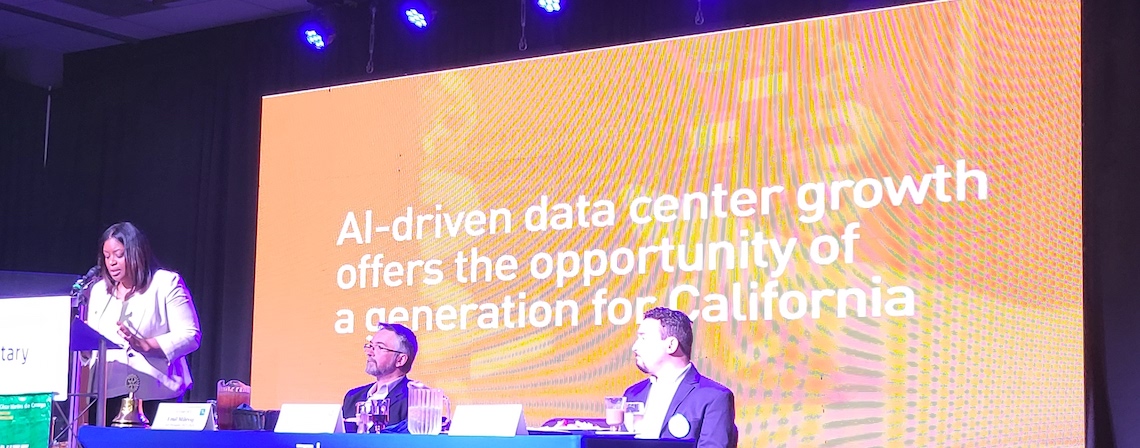
Carla J. Peterman, president of PG&E Corp., addresses the Rotary Club of Fresno on Monday, March 23, 2026. Seated at right are Rotary members Emil Milevoj and Blake Zante. Photo by Gabriel Dillard
Written by Gabriel Dillard
The AI data center boom could be a potential benefit for PG&E ratepayers in the Central Valley, according to Carla J. Peterman, president of PG&E Corp. and executive vice president of customer and corporate affairs.
Peterman addressed the Rotary Club of Fresno on Monday, making the case that the region is unusually well-positioned to absorb the massive power loads that AI data centers require — and that every gigawatt of new load brought onto the grid drives residential rates down by roughly 1%.
“You start to add that up and it makes a difference,” she said.
California’s grid currently operates at about 45% of capacity, built to handle peak demand. Peterman said bringing large new loads online during off-peak hours shifts the economics in consumers’ favor.
PG&E conducted a cluster study of AI and data center applicants and found most fall in the 40 to 100 megawatt range — what Peterman called a “Goldilocks” zone. About two-thirds of those applications came from the Central Valley. The timeline calls for self-funded substation work with activation by 2030. Already, 100 megawatts of new load is coming online in San Jose as an early example of the model in action.
A March study from the Next 10 think tank and University of Pennsylvania researchers found that placing data centers near solar generation sites in Fresno County could tap into energy that is currently being curtailed — shut off because transmission lines are congested. A 20-megawatt Fresno County data center could theoretically run on that stranded solar power for about 54% of the year, according to the study.
Ethan Smith, senior vice president at Newmark Pearson Commercial, said the region’s energy surplus is a genuine asset. “Having excess energy at potentially lower rates is a valuable component of the site selection process,” Smith said, though he noted connectivity infrastructure remains a critical factor developers weigh alongside power costs.
Peterman said data centers are expected to pay their own infrastructure costs upfront, with Public Utility Commission proceedings underway to formalize that framework. Rate increases for existing customers are not part of the deal.
“It’s not part of their social contract if there’s a rate increase,” she said about the data center developers.
PG&E has already reduced residential bundle rates five times since a 2024 peak, for a cumulative drop of about 13%, driven in part by $3.5 billion in operational savings, Peterman said.
The utility employs 6,000 people across the Central Valley.
Related Posts
-
 Who’s driving? Fresno gig workers push for rules on driverless cars Posted: March 25, 2026 at 2:57 pm
Gig workers and labor organizers gathered at Fresno City Hall
Read more » -
 Fresno State changes its sports marketing model after decades Posted: at 2:52 pm
Fresno State Athletics announced the launch of Bulldog Sports Enterprises,
Read more » -
 Fresno staffing firm partners with EDC to place workers at no cost to employers Posted: at 12:25 pm
Denham Resources, a leading staffing and human resources consulting firm
Read more » -
 Valley Children’s new pediatric residents through national match Posted: March 24, 2026 at 3:55 pm
Valley Children’s Hospital has welcomed 14 new physicians into its
Read more »
Central Valley Biz Blogs
-

BLOG: The Central Valley — California’s manufacturing bright spot
Posted: March 13, 2026 at 2:07 pm
If you follow the headlines, you might conclude that manufacturing
Read more » -

BLOG: California’s tribal casinos trample smaller cardrooms with new regulations
Posted: March 11, 2026 at 9:18 am
While writing a book about California politics a quarter-century ago, I devoted
Read more »