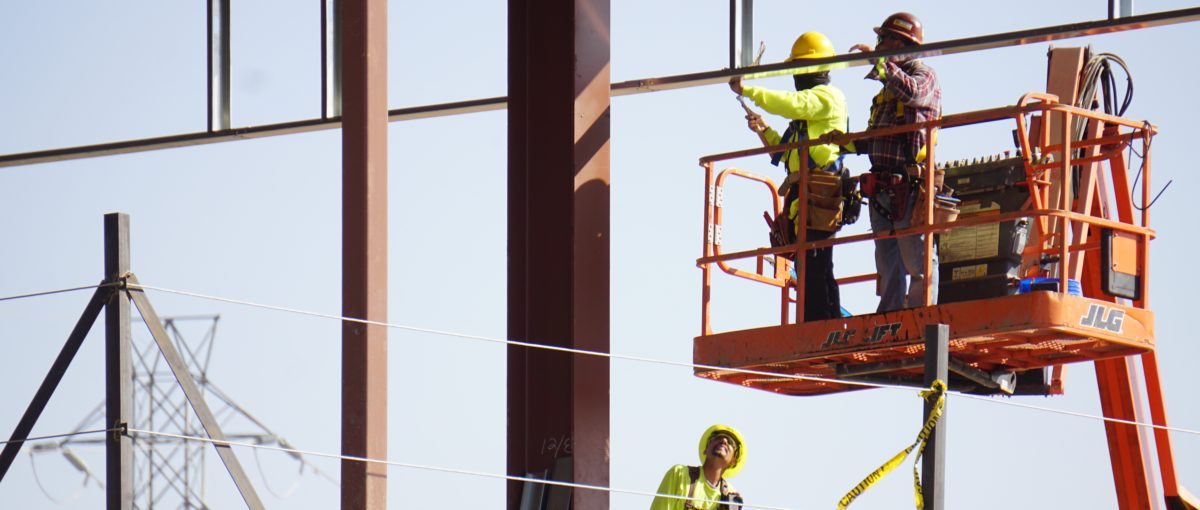
Construction file photo
Written by Frank Lopez
Construction in the Central Valley was rife with activity in 2025, and while there might be a lull this year, there is still a positive outlook for 2026 and beyond.
That trend is reflected on a national level as well.
Total construction expanded by 5.4% in 2025, according to Dodge Data and Analytics, a news and intelligence provider serving the North American commercial construction industry.
Though nonresidential starts were up 4.5%, residential starts were down by 4.8% and nonbuilding starts were 18.7% higher when compared to 2024.
In Fresno, the data forecasts a climb of 20% in 2026, with gains expected for new starts across all three major construction categories—residential, non-residential, and non-building construction.
Non-residential starts are expected to climb 23% in 2026 and are forecast to top $2.5 billion.
The construction boom in the city is driven by major projects including the recent completion of a terminal expansion at Fresno Yosemite Airport, various hotel projects including one next to the Fresno Convention Center, work on the California High Speed Rail across the Central Valley, roadwork, and several infrastructure projects such as water and sewer improvements in Downtown Fresno.
There were also various health care construction projects completed in late 2025, including Kaiser Permanente’s Orchard Plaza Medical Offices, Community Health System’s Burnett Extended Care Center, and a remodeling of the Fresno County Department of Behavioral Health’s 115,000-square-foot building.
In January, the Fresno City Council approved the construction of a new WelbeHealth senior facility, which is expected to be completed in March 2027.
Residential construction in Fresno is forecast to top $7.8 billion, according to Dodge Data & Analytics — $6.9 billion for single-family.
Total non-building construction, which includes projects such as highways and bridges and other public works, is forecast to top $6.5 billion in 2026.
Mike Spencer, president of Harris Construction, said the company has a generally positive outlook for 2026 and noted there is a significant round of public work and infrastructure work on the horizon.
Spencer said there could be a “flatline” because it takes time for public agencies to get projects on the drawing board, work them through the approval process, and get them out to bid.
“We predict that late 2026, 2027 and 2028 are going to all be very good. We are going to have a dry spell here for a couple of months while a lot of the work in our industry is being burned through. We are still seeing record numbers. There is plenty of work in the market,” Spencer said.
Many companies with big projects are currently going through the entitlement and approvals process, Spencer said.
Matt Davies, vice president of preconstruction at Harris Construction, said designers, engineers, and architects are currently at capacity in the design phase, which has led to a slowdown in construction activity.
“Harris is coming to a close on a lot of larger projects and so we are seeing a little slowdown. But on the flipside we think things are very positive because the design is very busy. Some of them are turning down work a little bit because they have such a packed workload,” Davies said.
Davies said the outlook will remain positive for the next 12 to 18 months, with the work cycle repeating itself.
On the labor end, Davies said a typical job could have about four to six contractors bidding—currently there could be upwards of 10.
Industry-wide, much of the subcontracting community is hungry for work as well.
When architects are busy with design, not many projects are coming to the street because they are in the design phase, he added.
“We think the future looks good. The slowdown isn’t troubling or concerning to us. The designers we talk to locally have a good, healthy backlog of design they’re working on. All the design has to go to construction at one point. There is not a cliff coming that is concerning,” Davies said.
Chuck Riojas, executive director of the Fresno, Madera, Tulare Kings Counties Building and Construction Trades Council, said construction job opportunities are the strongest he has seen in his 39 years in the trades, including projects ranging from the High Speed Rail to road work in local cities and counties.
Through partnerships with local job training programs, such as the Valley Build Now program, the trades are training the next generation of the workforce, he said.
“We are going to create the next generation of workers here with local people,” Riojas said.
These job opportunities range from surveyors and carpenters to operating engineers, electricians, and plumbers.
However, he said all the trades will benefit because strong infrastructure will attract industry to the area.
It will also attract more people to want to live in the Central Valley so they can be closer to the work, Riojas said.
Related Posts
-
 After ‘flatline,’ Fresno construction forecast to climb 20% in 2026 Posted: March 2, 2026 at 2:32 pm
Construction in the Central Valley was rife with activity in
Read more » -
 Stan Oken, who shaped Fresno through business, public service and education, dies at 97 Posted: at 1:39 pm
Stan Oken, World War II veteran, former Fresno County supervisor,
Read more » -
 Fresno’s hottest taco truck is getting a storefront — and it could open this week Posted: at 11:29 am
Tacos El Cabezon, the wildly popular Mexicali-style taco truck that
Read more » -
 Lee’s Air in Fresno welcomes Derek Franks, formerly of Grizzlies, as COO Posted: at 10:17 am
Lees Air, Heating & Plumbing has announced Derek Franks, former
Read more »
Central Valley Biz Blogs
-

BLOG: Preparing for the next wave of franchise mergers and acquisitions
Posted: at 2:22 pm
After two years of subdued activity, the franchise M&A market
Read more » -

BLOG: Fresno families caught in the middle as Blue Shield, Community contract standoff drags on
Posted: February 26, 2026 at 4:06 pm
A contract dispute between Blue Shield of California and Community
Read more »