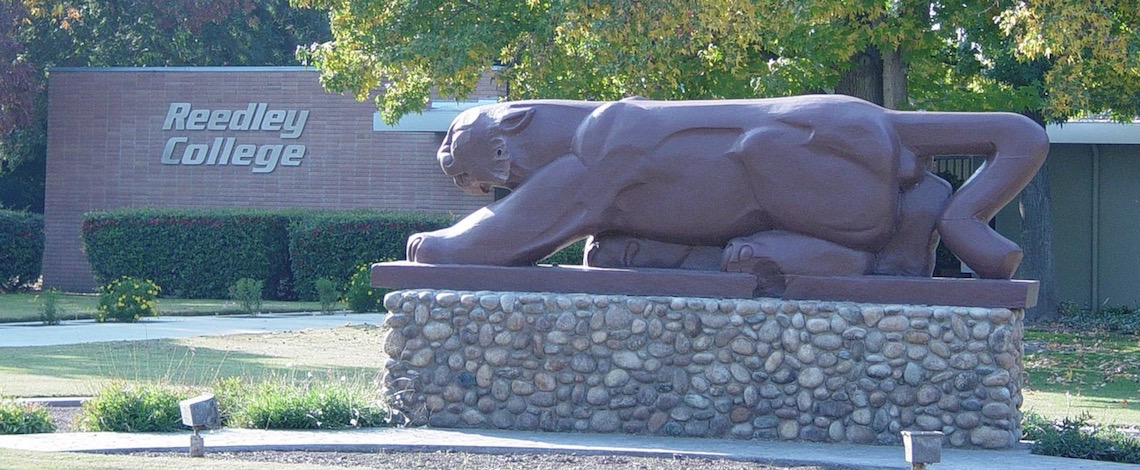
Reedley College file photo
Written by
Thanks to a $4 million federal grant awarded to College Bridge, a group of local colleges will partner with 21 high schools to promote equity in mathematics via dual enrollment for Black and Latino students next fall.
With a total budget of $6.7 million, the Dual Enrollment Math Bridge Project was awarded the five-year U.S. Department of Education grant for the participating colleges to provide college-level math courses that will improve and support college readiness in various rural areas.
The participating community colleges are Cerro Coso in Ridgecrest; Columbia in Sonora; Madera, Reedley, Taft and West Hills College Coalinga.
“For this grant, Dual Enrollment Math Bridge will include nearly 8,000 low-income, Black or Latino 11th or 12th grade students who lack access to rigorous math courses,” said Dr. Lynn Cevallos, founder and president of College Bridge, a California non-profit based in Los Angeles County dedicated to forging a path towards both college access and success for underrepresented students.
Cevallos created College Bridge in 2011 with the mission “to transform the K-16 educational system by identifying and eliminating barriers that prevent underrepresented students from progressing to and through college.”
“This DE Math Bridge project is an innovating high school intervention that will close equity and attainment gaps in college math and college completion at the 21 Central Valley rural high schools within the six colleges’ service areas,” she said.
Participating colleges are members of the Central Valley Higher Education Consortium (CVHEC), which is made up of 30 institutions of higher education in the Central Valley’s nine-county region and includes 15 community colleges and four multi-campus community college districts.
The project is based on the Math Pipeline Readiness Project (M-PReP), an evolving series of longitudinal research and practice projects that College Bridge has successfully implemented since 2013.
One M-PReP success story occurred in 2018 at Dinuba High School, a Tulare County school that served 1,988 students at the time — 82% of which are socioeconomically disadvantaged and 93% Latino.
The program resulted in increased college readiness for students who also earned college credits.
The names of the participating high schools will not be released until February.
Related Posts
-
 Fresno company goes global as ERI plans first international facility in Japan Posted: March 24, 2026 at 12:00 am
Electronic Recyclers International (ERI), the nation’s largest electronics recycler, has
Read more » -
 Fashion Fair Mall could land a Dick’s House of Sport. First, a 55-year-old building has to come down Posted: March 23, 2026 at 3:11 pm
A proposed Dick's Sporting Goods store at Fashion Fair Mall
Read more » -
 AI data centers could be a rate-relief engine for Central Valley, PG&E president says Posted: at 2:25 pm
The AI data center boom could be a potential benefit
Read more » -
 Fresno’s beloved comics den reborn as a Michelin-recognized taqueria Posted: at 11:41 am
As seen on Netflix — a Michelin recognized Mexican restaurant
Read more »
Central Valley Biz Blogs
-

BLOG: The Central Valley — California’s manufacturing bright spot
Posted: March 13, 2026 at 2:07 pm
If you follow the headlines, you might conclude that manufacturing
Read more » -

BLOG: California’s tribal casinos trample smaller cardrooms with new regulations
Posted: March 11, 2026 at 9:18 am
While writing a book about California politics a quarter-century ago, I devoted
Read more »